The honest answer isn’t a simple yes or no. Here’s how to see it.
Navagio status, updated June 2026
- Beach: closed to landings
- Swimming in the cove: not allowed
- Boats: may enter the bay, but must stay at least 50 meters from shore
- Clifftop viewpoint above Anafonitria: open and free
- Restrictions run through: 31 October 2026
- Confirmed reopening date: none
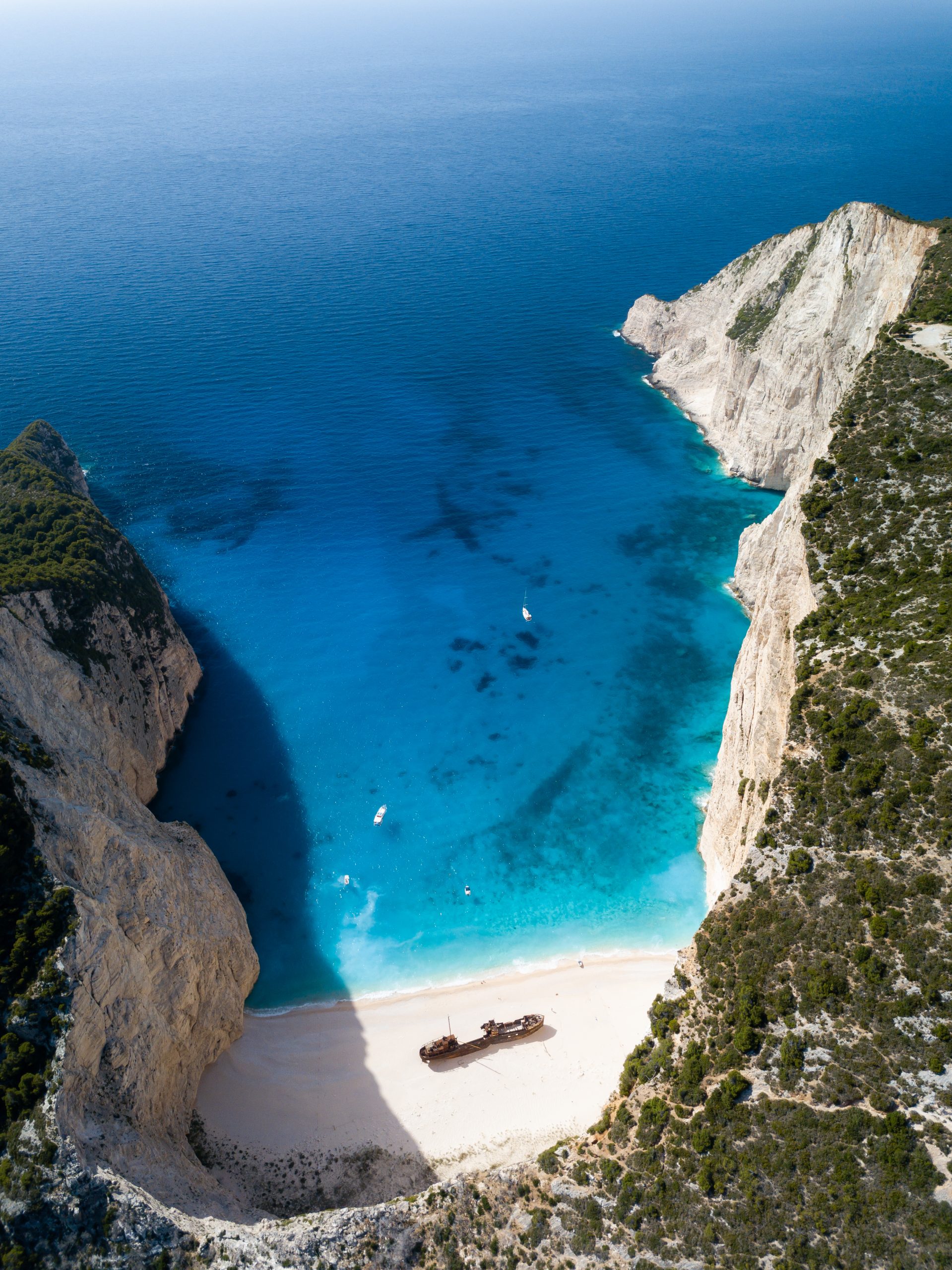
Navagio Beach is closed to landings in 2026. The short answer is no: you won’t stand on the sand beneath the wreck, and you won’t swim out to the rusted hull either. The beach is closed to landings, and Greek authorities have extended the ban through 31 October. What’s left is the view, from the clifftop above Anafonitria or from a boat holding its distance offshore. Both are worth the trip. It’s still one of the better mornings you can have on Zakynthos. Just not the one you saw on Instagram.
The rest of this guide is about doing it right, and about ignoring the pages online that still tell you to wade ashore and touch the ship.
What’s actually closed
Most of the confusion comes from people assuming the whole site is sealed off. It isn’t. There are three different things here, and only some of them are closed.
| Activity | Allowed in 2026 |
|---|---|
| Seeing the bay from the viewpoint | Yes |
| Photos from the platform | Yes |
| Boat trip into the bay | Yes, but no closer than 50 meters |
| Walking on the beach | No |
| Swimming out to the wreck | No |
| Anchoring or swimming inside the bay | No |
Authorities have drawn a prohibited zone right at the sand and a controlled-access zone around it. Both are off limits this season. The clifftop viewpoint is a separate matter, and it’s open.
Why the Navagio beach is closed
Navagio has a long history of rockfall. The closures have come in waves, not as a single decision.
In 2018, part of the cliff face broke away and fell onto the sand. Seven people were injured, and the bay closed while geologists assessed it. Then, in September 2022, a magnitude 5.4 earthquake hit the water between Zakynthos and Kefalonia. A large section of cliff gave way, and Greece’s earthquake-protection agency classified the bay as unsafe for landings. Walking and swimming on the beach itself have been banned since.
The latest extension came in June 2026, after a tourist fell from the cliff near the viewpoint. A fresh risk assessment followed, and the ban was carried through to 31 October 2026. The authorities have said they’ll review safety twice a year. A return to the pre-2018 days of open, unmanaged access looks unlikely any time soon.
The takeaway is simple. If an operator promises you a landing in Navagio Bay this summer, that’s your cue to book someone else. They’re either out of date or counting on you not knowing better.
How to see Navagio beach now
There are two ways to see the wreck in 2026. Most people pick one. Anyone with a free morning does both.
The viewpoint above Anafonitria
The classic photo, ship far below, turquoise water, white cliffs, is taken from here, not from the sand. The platform sits on the northwest coast above the village of Anafonitria, about 40 minutes by car from Zakynthos Town. Allow closer to 50 in July and August. The approximate coordinates are 37.859°N, 20.624°E; confirm the pin in Google Maps before you drive.
At the top you’ll find a gravel parking area, a small kiosk selling cold drinks, and a couple of toilets. From there it’s under five minutes on foot to the main platform. The railing has been reinforced, and the platform now sits a sensible distance back from the edge. A few smaller, unofficial lookouts run along the path, and they’re often better for photos, because the main platform tends to have a line.
Go between nine and eleven. The sun is on the cliffs and the sand, the boats haven’t gathered below yet, and the crowding hasn’t started. After eleven in high season, expect a ten to fifteen minute wait for the best spot. The viewpoint closes at sunset, and there’s no lighting up there. That narrow road in the dark is not something you want to meet for the first time.
The viewpoint isn’t wheelchair accessible. The parking is gravel, and the path, though short, is uneven.
One warning worth taking seriously: the wind on the edge is strong. Hats go, drone footage shakes, and the edge is no place for a selfie. People have died here, and the most recent closure followed a fall. The platform gives you the shot everyone comes for. Anything past the railing is real danger, not a better angle.
By boat, from the water
For the closer view, the one where the wreck fills the frame and the cliffs run well over a hundred meters straight up, you go by boat. There are three sensible departure points.
Porto Vromi is the closest and fastest. The small fishing harbor sits on the west coast, about 25 minutes by car from the viewpoint, and boats from here reach Navagio in fifteen to twenty minutes. Less time at sea means more time at the wreck. The boats are smaller, the ride calmer, the crowds thinner. It’s usually the local choice. The harbor sits at roughly 37.77°N, 20.62°E.
Agios Nikolaos, in the far north, pairs well with the Blue Caves at Cape Skinari. Boats run out to the caves first, then south to Navagio, over three to four hours.
Zakynthos Town is the longest and most touristed option. The big day cruises leave from the main port, run six to eight hours, include lunch and several stops, and sometimes a turtle-spotting attempt in Laganas Bay. Fine if you want a lazy day on a boat with food included. Less local, more cruise.
Wherever you start, the same rule applies. The boats don’t land, and they have to stay at least 50 meters off the shore. No anchoring, no swimming inside the bay. You photograph the wreck and the cliffs from the water, and the swim stop happens in a neighboring cove rather than at the beach. Two we’d choose: Xygia, a sulfur beach where springs bubble up under the cliff and the water is said to be good for your skin, and Porto Limnionas, a deep cove on the west coast with clear water and a small taverna at the top.
What a trip costs in 2026
| Type of trip | Departure | Length | Price per person |
|---|---|---|---|
| Short boat trip | Porto Vromi | 1.5 to 3 hours | €20 to €35 |
| Full-day cruise | Zakynthos Town | 6 to 8 hours | €40 to €60 |
| Combo: viewpoint and boat | With transport | Half day | €55 to €75 |
Prices move with the season and the departure point, and usually include a swim stop in a neighboring cove. Confirm the distance and landing rules with your operator a day or two before you go, because they change from year to year.
Should you pair Navagio with the Blue Caves?
If you’re leaving from Agios Nikolaos in the north, usually yes. The Blue Caves sit at Cape Skinari on the island’s northern tip, a run of low sea caves where sunlight hits the white limestone below the surface and throws a hard blue up into the cave itself. The boat takes you inside. On a still morning the water looks almost unreal. Most of the northern Navagio trips run the caves as a first stop, and the pairing gives you the island’s two most-photographed places in one morning.
Timing decides everything here. The light in the caves is best early, before the wind picks up and before the day boats come north from town. Leave from Porto Vromi to save time for the wreck, and you skip the caves. It’s a real trade-off, not a default.
Can you fly a drone over Navagio?
This is the question most guides skip, and it deserves a straight answer, especially now that the aerial is the only way to see the whole bay.
Greece follows the EU’s EASA rules, and the Hellenic Civil Aviation Authority requires registration for any drone with a camera. The basics: 120 meters maximum, daylight only, and you keep the drone in sight at all times. You can’t fly over people, over boats, or over protected nature areas.
Navagio isn’t a designated no-fly zone, but two things make it one in practice. The viewpoint is full of people for most of the day, and the bay below is full of boats. You’re barred from flying over either. The turtle park in the south, in Laganas Bay, is a protected area where pilots have been fined for flying too close to the turtles in nesting season. Navagio is nowhere near the park, but it shows how strictly this gets enforced. Check the Greek drone map for temporary restrictions before you put anything up.
The aerials of Navagio are extraordinary. They’re also shot inside rules stricter than most people assume. Learn them before you pack the propellers.
The story of the MV Panagiotis
The wreck is why the world knows this bay, and the story behind it is better than most people realize.
| Detail | |
|---|---|
| Built | 1937, Scotland |
| Original name | Saint Bedan |
| Length | 48 meters |
| Ran aground | 2 October 1980 |
| Status today | Wreck under a conservation program |
The ship was built in Scotland in 1937 and originally named Saint Bedan, a small coaster of 48 meters. It changed hands and names more than once, to Meropi in 1964 and Charis in 1966, before becoming Panagiotis in 1975. By then it was an old vessel.
In the early hours of 2 October 1980, around half past four, in a storm and poor visibility, it ran aground in the bay then known as Agios Georgios. The most widely accepted version has the Panagiotis under a Panamanian flag, carrying about 2,000 cases of contraband cigarettes worth an estimated 30 million drachmas, running from Turkey toward Italy with the Greek Navy in pursuit. The crew abandoned ship to get away, and 29 locals were later convicted of looting the cargo.
There’s a competing account. The captain, Charalambos Kompothekras-Kotsoros, said the cargo was legal and bound from Argostoli to Durrës, that the ship was driven ashore in the storm, and that the looting was the real crime. He alerted the authorities himself and was never charged. Recently released court documents lean toward the smuggling version.
Whichever is true, the name Agios Georgios slipped out of use. The bay became Navagio, Greek for shipwreck. The fame took off in earnest when the Korean series Descendants of the Sun used the spot in 2016, sending a wave of Asian visitors to a beach that was already among the most photographed in Europe.
When will Navagio reopen?
There’s no confirmed date, but there is a plan, and it’s specific.
The Greek state has approved an intervention of between €8.5 and €9 million, running from 2026 to 2030. Three things are meant to happen. The beach will be replenished and widened by about 30 meters to fight erosion. The wreck will be conserved through the EU’s Interreg program, to stop the decay and hold the hull in place. And the cliffs will be stabilized, with a stated aim of eventually allowing landings again.
There’s a quieter change too. For the first time, the bay is under the management of the Municipality of Zakynthos, after years of uncertainty over who was responsible. The plan rests on a study from the National Technical University of Athens, where a large research team mapped both the wreck and the cliffs.
The closure isn’t only a geological measure. The bay was badly overloaded before the restrictions, with hundreds of visitors pressed onto a narrow strip of sand under unstable cliffs. The new municipal control sits inside a wider Greek shift toward managing the pressure on its most-photographed sites, in step with the visitor levies appearing elsewhere in the country. For a traveler in 2026, though, the reality is unchanged: the viewpoint, and the boat from the water. The rest is a construction site with a five-year horizon.
Getting there
In high season there are direct flights from Oslo to Zakynthos, about three hours and forty-five minutes, on carriers including Norwegian, SAS, and Aegean. Outside summer you’ll generally connect, often through Athens. The airport sits just six kilometers from Zakynthos Town, so the hop from plane to hotel is short.
The best window for the Navagio trip is May to June or September. Milder, fewer people, and a calmer sea for the boat. July and August mean lines at the platform and heat with no shade.
Where to stay
There’s no luxury lodging at Navagio itself. The northwest coast is all but undeveloped, which is part of the appeal. The best hotels are east and north, so the logic is straightforward: stay where the amenities are, and take Navagio as a day trip. To cut the time at sea, base yourself west, near Porto Vromi, though the choice there is thinner and more villa-led.
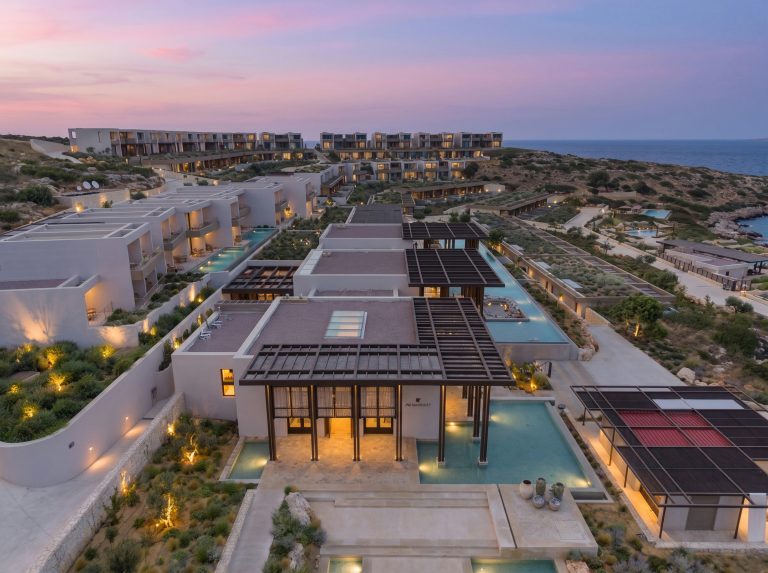
Among the premium options, Porto Zante Villas & Spa is the name people know, with private-pool villas at the water. Lesante Cape and Lesante Blu are both members of the Leading Hotels of the World, while Olea All Suite is a Design Hotels property for travelers who want architecture over all-inclusive. All sit a drive from the wreck, but so does the whole island.
Is it worth it in 2026?
Yes, with your eyes open. You’re no longer going to lie on one of the world’s most famous beaches, because you’re not allowed to. You’re going for the view, and the view is still absurd. The ship in the sand, the vertical cliffs, water in a color that looks edited even when it isn’t.
The honest plan is to drop the expectation of the sand and work with what’s possible. Viewpoint at nine, boat from Porto Vromi around eleven, a swim at Xygia, lunch in a Volimes village taverna, home by early afternoon. That’s a good day on Zakynthos. Anyone selling you more than that right now is selling a closed beach.
Frequently asked questions
Is Navagio Beach open in 2026? The bay is open for viewing, but the beach itself is closed to landings through October 2026. You can see the wreck from the viewpoint above Anafonitria and from a boat, but you can’t go ashore, swim out to the ship, or approach it.
Can you walk on Navagio Beach in 2026? No. The beach has been closed to walkers and swimmers since a rockfall after the 2022 earthquake, and the ban runs through 31 October 2026 for safety.
Can boats still go into Navagio Bay? Yes, but they have to stay at least 50 meters from shore. Anchoring and swimming inside the bay aren’t allowed. The swim stop on the tours happens in a neighboring cove, not at the wreck.
Is the viewpoint open? Yes. The clifftop viewpoint is open and free, about 40 minutes by car from Zakynthos Town. The classic photo of the wreck is taken from here.
Which boat tours still go to Navagio? Tours from Porto Vromi (closest and fastest), Agios Nikolaos (north, paired with the Blue Caves), and Zakynthos Town (the longest day cruise) all run. None of them land on the beach.
What does a Navagio boat tour cost in 2026? Short trips from Porto Vromi run €20 to €35 per person, full-day cruises from Zakynthos Town €40 to €60, and combined viewpoint-and-boat tours €55 to €75 with transport included.
Is Navagio Beach worth visiting with the beach closed? For most people, yes. The view from the cliff is still among the best in Greece, and from a boat the wreck becomes a large, rusted hull seen up close. What you miss is standing on the sand itself. Plan for that, and it’s a good day.
When will Navagio Beach reopen? There’s no confirmed date. A restoration project worth €8.5 to €9 million is set to run from 2026 to 2030, widening the beach, conserving the wreck, and stabilizing the cliffs.
Last updated: 24 June 2026. The rules at Navagio change from season to season. Always confirm distance and landing rules with your boat operator a day or two before you go.