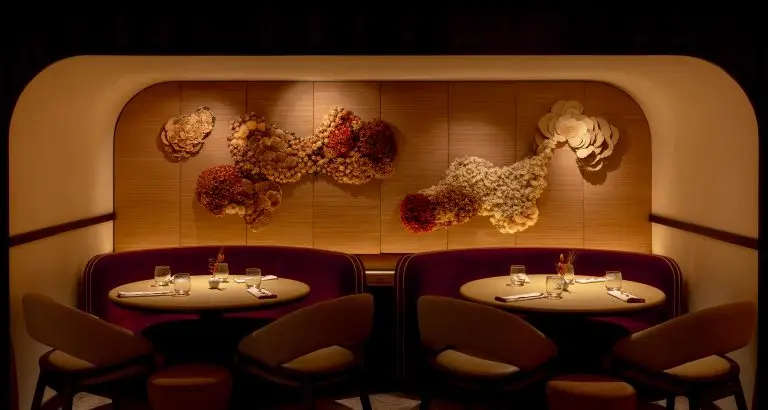
Aman’s founder opens Azuma Farm Koiwai in Iwate, Japan, a slow-luxury retreat where guests reconnect with nature and seasonal rhythms.
Aman founder Adrian Zecha is 93. His new project, Azuma Farm Koiwai, opens this April in northern Japan, and it is doing something Aman never quite did.
You can probably guess what slow luxury looks like by now. Quiet rooms. Local materials. A view of something that took millions of years to form. Adrian Zecha figured this out in 1988 when he opened the first Aman in Phuket, and the rest of the industry has been catching up ever since.
So when the man basically credited with inventing high-end Asian hospitality opens a new place at 93, you would expect a victory lap. Maybe a refined Aman, in some breathtaking spot Aman somehow missed. What he has actually done is weirder, and a lot more interesting.
Azuma Farm Koiwai opened on 23 April in Iwate Prefecture, two hours and twenty minutes north of Tokyo on the Shinkansen. It sits inside Koiwai Farm, a 3,000-hectare working dairy and forestry operation that began in the 1890s as an attempt to coax something out of a stretch of barren volcanic ground. The attempt worked. Koiwai is now one of Japan’s most lovely agricultural landscapes, and Azuma Farm is the first hotel anyone has ever been allowed to put inside it.
The brand is a partnership between Kyoto hospitality company Naru Developments (Zecha is chairman) and JR East, the railway. Twenty-four villas. Eight hectares. A new concept they are calling “Farm Life.”
The Hayase factor
It is worth pausing on Zecha’s collaborator here, because the press coverage has mostly skipped him. Fumitomo Hayase spent twelve years inside Aman, overseeing the development of Aman Tokyo and Amanemu, before founding Naru in 2017. His first project with Zecha under the new partnership was Azumi Setoda, a ryokan-inspired property that opened in 2021 on the island of Ikuchijima in the Seto Inland Sea. Azumi was Japan through the lens of the coast, the bath, the pan-Asian exchange that has shaped the country since the Meiji era.
Azuma Farm is the inversion. Azuma means “the East,” a pointed, almost defiant gesture toward Tohoku, the region of northern Honshu that sits almost completely outside the established Japan luxury map. Where Azumi looks out to sea, Azuma Farm turns inland: to forest, to pasture, to the working land.
Hayase has spoken in interviews about a single principle absorbed from Zecha over the years, that the site, not the designer, determines what a place should become. You can see that principle being applied here with unusual literalness.
A farm, not a stage set
Architect Shiro Miura, of Kyoto firm Rokkakuya, walked the forest with the Koiwai team before he drew anything. They picked the trees one by one. The villas are built mostly from those exact red pines and Japanese cedars, with windows on three sides and no plastic anywhere on the property. The aesthetic borrows from sukiya, the contemporary tea-house tradition Miura is known for: clean lines, natural finishes, an almost ascetic sense of restraint.
You can feel where this comes from. It is recognisably a Zecha building. But it is also, somehow, more humble. Aman tends to feel like sanctuary. This feels like shelter.
Where Aman asks you to look at a landscape, Azuma Farm asks you to do something inside one. Mornings might involve a harvest, or a horseback ride through the Ainosawa pastures (Iwate has been horse country for centuries, and Mount Iwate is right there, looming). Afternoons could mean a workshop with an 11th-generation Nanbu ironware master, casting your own kettle. Or a lacquer tour exploring Joboji Urushi, the same technique used to restore some of Japan’s oldest temples and shrines.
It is not curated, exactly. Or rather, it is curated, but the curation defers to the farm. Things happen because it is the season for them, not because there is a daily activity sheet.
Iwate, on the plate
Chef Yoshitaka Oyama is an Iwate native, and his menu is essentially a regional argument. Grilled kichiji, a fatty local fish from the Sanriku coast, comes with bottarga. Tankaku wagyu T-bone gets charcoal-grilled with carrots. Dairy comes off Koiwai’s own herds, which is a bit of a flex. Koiwai produces some of the most respected milk and cheese in Japan. Breakfast leans heavily on what came in that morning, including milk so fresh it resets your idea of what milk is.
Sommelier Shinichi Sasaki runs the pairings omakase-style across sake, wine, and Japanese spirits. An aged Masuizumi sake against handmade cheese from nearby Cheese Kobo is, by several accounts, the moment of the meal. The wine list is regional and confident enough to skip the obvious French references entirely.
Three 89-square-metre sauna pavilions called Forest Springs sit elsewhere on the grounds. Each one has a wood-fired sauna, a cold bath, a fireplace, and daybeds opening onto the trees. You can use them in the daytime, but the recommended time is dusk, when the temperature drops and the forest goes quiet.
Why Tohoku, why now
The decision to plant this brand in Iwate is not incidental. Tohoku is one of Japan’s most agriculturally rich regions and one of the least visited by international travellers. The Shinkansen reaches Morioka, Iwate’s capital, in two hours and twenty minutes from Tokyo Station, but most of the world still flies straight past to Kyoto, Osaka, or the ski resorts of Hokkaido. Morioka itself is a small revelation: a thriving kissaten coffee culture, historic temple districts, izakaya alleyways, and a slow-walking pace that feels deeply un-Tokyo.
The region’s challenge has always been visibility, not substance. Iwate has the Sanriku coastline (some of the best seafood in the country), Mount Iwate (an active stratovolcano with hiking and onsen), and a craft tradition that has supplied Japan’s temples for centuries. What it has not had, until now, is a hospitality offering capable of pulling international luxury travel northward in any meaningful way. Azuma Farm Koiwai is being framed by JR East and the Iwate prefectural government as a gateway property, a base from which guests can be introduced to the wider Tohoku circuit, including the folklore-soaked town of Tono and the lacquer villages of Hachimantai.
Whether Azuma Farm Koiwai can shift the centre of gravity of an entire region’s tourism remains to be seen. But the Belmond model, pair a marquee accommodation with a curated regional programme and let the brand pull the visitors, has worked elsewhere. JR East is clearly betting it will work here.
Why Azuma Farm Koiwai matters
You could read all of this as Aman with farm dressing. It is not. The shift is small but real.
For 38 years, Aman has sold the idea that the great luxury is a beautiful empty room with a view of something extraordinary. The room contemplates. You contemplate. Nothing is asked of you. Azuma Farm reverses that contract. The room still gets out of your way (Zecha would not allow otherwise), but the days are not contemplative. They are participatory. You are inside the farm’s rhythm rather than watching it through glass.
That is a different proposition, and it is being made at a moment when the audience for it has finally caught up. The same generation that drove Aman’s success in its first decades has aged into a different kind of indulgence. They have already seen the view. What they want now is to be useful, briefly, in someone else’s landscape.
The 93-year-old hotelier who taught the luxury industry to slow down is now telling it, gently, to get its hands dirty. Azuma means east. The brand is pointing somewhere new, and given who is doing the pointing, the rest of the industry will probably follow.
Azuma Farm Koiwai opens 23 April 2026 in Shizukuishi, Iwate Prefecture, Japan. Bookings via azumafarms.com.