Inside Belmond’s first Paris to Amalfi Coast journey – and why the inaugural sold out in days.
The Venice Simplon-Orient-Express Amalfi Coast route is finally here, linking Paris with Italy’s southern shoreline for the first time…
The Venice Simplon-Orient-Express’s first-ever Paris to Amalfi Coast route is finally here. The inaugural train pulled out of Gare de l’Est on Sunday and, predictably, sold out within days.
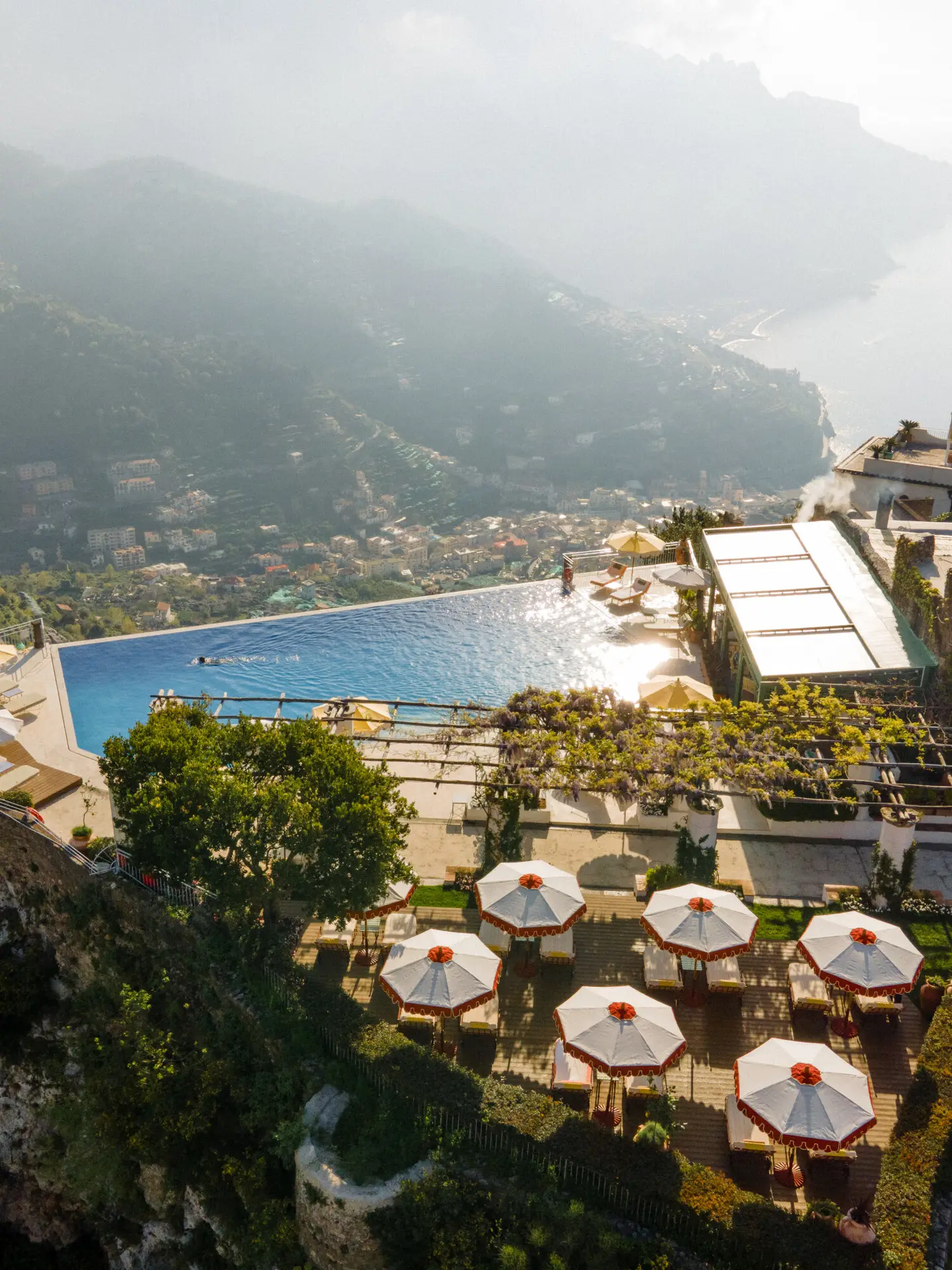
Somewhere over the past 48 hours, in one of the meticulously restored 1929 sleeping cars of the Venice Simplon-Orient-Express, a guest has been sipping coffee from bone-white French porcelain while watching the Italian countryside scroll past their window. By tonight, they’ll be standing on the Wagner Gardens terrace of an 11th-century palace 1,200 feet above the Tyrrhenian Sea, dressed for dinner, with the lights of Amalfi twinkling somewhere far below. Total journey: three nights, two countries, one lifetime of bragging rights.
This is what Belmond has decided travel should look like in 2026.
On 4 May, the Venice Simplon-Orient-Express (the storied midnight-blue train operated by LVMH-owned Belmond) ran its first-ever Paris to Amalfi Coast route. It is the most ambitious instalment yet in the brand’s Italian “Villeggiatura by Train” series, which pairs an overnight rail journey with a multi-night stay at a Belmond hotel. The inaugural departure ends with two nights at Caruso, the brand’s clifftop palace in Ravello.
It also costs from £8,600 (around $11,540) per person sharing a Historic Cabin, and rises briskly from there.
That price gets you a Champagne welcome, hours of staring at French and Italian countryside through Lalique glass, dinner from the kitchens of Michelin-starred Jean Imbert, a guided tour of Pompeii (Grand Suite guests get exclusive access to Casa del Larario in Regio V, an excavated Pompeian house ordinarily closed to the public), and the kind of slow, ceremonial unfolding that has quietly become luxury travel’s most coveted commodity.
Why now, and why this route
The Amalfi Coast has, for decades, presented something of a logistical insult to its own glamour. Most visitors fly into Naples and then endure a long road or ferry transfer along narrow, vertiginous coastal roads to reach Ravello or Positano. Belmond’s new Paris to Amalfi Coast itinerary, in effect, removes the indignity. You step onto polished marquetry in Paris and step off, pre-changed and properly fed, at the gates of a hotel where Greta Garbo, Jacqueline Kennedy and Virginia Woolf once decompressed.
That’s the practical case. The cultural one is more interesting. Belmond, owned by LVMH since 2019, is doing something rather shrewd here: turning travel into a chaptered narrative. The train is Chapter One. Pompeii is the interlude. Caruso is the third act. Each is curated, paced and designed to lead seamlessly into the next, with no airports, no transfers, no “where do we change for the bus?” panic. As Pascal Deyrolle, general manager of the Venice Simplon-Orient-Express, has put it, the route reveals “cliffs, villages, and sea views in a way that only the Venice Simplon-Orient-Express can provide.”
The timing is also not coincidental. With Accor’s Orient Express brand (yes, there are now two Orient Expresses; we’ll get to that) opening competing hotels in Rome and Venice, and a brand-new Paris-to-Istanbul Accor service due in late 2026, Belmond is reminding the market who has been doing this since 1982, and who has the original 1920s rolling stock to prove it.
What it actually feels like on board
Forget anything you may have absorbed from a corporate press release. The 17-carriage train is essentially a working museum: original Compagnie Internationale des Wagons-Lits sleeping cars from the 1920s and ’30s, including Sleeping Car 3309 (marooned in a snowdrift in 1929, the incident that inspired Agatha Christie’s Murder on the Orient Express) and Sleeping Car 3425 (associated with King Carol of Romania’s flight from his country in 1940 with his mistress in tow). It’s not a theme park. The Lalique panels are real. The Chinese lacquerwork is original. The exquisitely restored marquetry comes from France’s Atelier Philippe Allemand, the same craft that built the carriages a century ago.
The 2026 train has one wholly new feature worth knowing about: L’Observatoire, a sleeper carriage designed by French street artist JR, which joined the rake last year. The most spacious accommodation on board, it is, in JR’s own words, “an artwork in motion”, complete with hand-painted stained glass by a 500-year-old German atelier, oculus skylights for stargazing, a secret tearoom and hidden marquetry messages JR estimates would take more than one journey to find. “The real luxury here is not the leather bench and the curtains,” JR told CNN in December. “It’s time. Your time on the train.”
Food on board is overseen by Jean Imbert (Top Chef winner, Michelin-starred former protégé of Alain Ducasse at Hôtel Plaza Athénée), who took over the kitchens in 2022 and has since redesigned the three 1920s restaurant cars (L’Oriental, Etoile du Nord, and the Lalique-glassed Côte d’Azur) to host candle-lit dinners on art-adorned French porcelain. Beef Wellington, roasted turbot in Hollandaise, tiramisu soufflé. Live piano music in Bar Car 3674. Breakfast served in your cabin as the Mediterranean countryside scrolls by.
And then, Ravello on the Amalfi Coast
The journey ends at Caruso, the Belmond hotel housed inside an 11th-century palazzo in Ravello, the Amalfi Coast’s quietest, most aloof clifftop town. The infinity pool, recently restyled, sits 1,000 feet above the sea. The hotel’s executive chef, Armando Aristarco, runs a “meet the makers” food programme rooted in Cilento (the UNESCO-recognised heartland of the Mediterranean Diet), using olive oil from a producer he calls Marco, tomatoes from one called Franco, white figs from someone called Enza. The gala dinner staged in the Wagner Gardens on the final night is built as an agora(the Ancient Greek word for marketplace), with Cilento producers showcasing their work alongside live music and traditional dance.
Guests can opt for a hands-on cooking class with Aristarco, a private boat to Positano, a painting lesson on the Loggia terrace with a local artist, or, entirely reasonably, none of the above and a deckchair.
The wider play
What Belmond is selling here isn’t really transport, or even hospitality. It’s the rare combination, in 2026, of provenance, craft, time, and a story you’ll be telling at dinner parties for the next decade. Demand for the Paris to Amalfi Coast route reflects this: rail industry analysts have flagged double-digit annual growth in premium European cabin bookings since the pandemic, and the Amalfi inaugural sold out within days of going on sale.
Whether one luxury route to a UNESCO-listed coastline can fix anything beyond its own bookings page is another question. But for the small, fortunate group of people who, over the next 48 hours, will descend the steps from carriage to platform to private transfer to clifftop palazzo, the Amalfi Coast is finally arriving the way it perhaps ought to: slowly, ceremonially, and on rails.
Villeggiatura by Train: Paris to the Amalfi Coast runs through 2026 from £8,600 per person sharing. belmond.com