Namibia’s finest camps are in the middle of nowhere, and that’s the whole point.
Ultimate Safaris Namibia: at a glance
- Who: Ultimate Safaris, founded 2008, Namibia’s leading conservation safari company.
- The camps: Onduli Ridge, Onduli Enclave, Camp Sossus, Camp Doros, Galton House (Windhoek), Meru Camp and Dome Camp.
- Price: From roughly $110 per person per night (Galton House) to around $770 and up (Onduli Ridge), fully inclusive of meals and activities at most camps.
- Power: 100% solar across every single camp.
- Awards: Tour Operator of the Year 2025, Conscious Tourism Operator of the Year 2025, Pure Awards Conservation 2024, Richard Bangs Best Hotels in the World Award 2024, PURE Award for Creativity, Wallpaper Design Awards 2019, TripAdvisor Travelers’ Choice Best of Best 2020. Featured in Condé Nast Traveller, Travel + Leisure, National Geographic, Harper’s Bazaar and The Times.
- Good for: Couples, photographers, nature obsessives, families with older kids, anyone who wants luxury without selling out their conscience.
- Not for: Those who need a pool bar, a DJ at sunset, guaranteed animal sightings, or fast Wi-Fi.
It’s five fifty-six in the morning. Franco kneels down and holds his hand one centimetre above an imprint in the red sand. He doesn’t say anything. He stays there a long time. I count to eighteen seconds. Then he stands, looks northwest, and points with his whole arm toward a dry riverbed two kilometres away.
He doesn’t say “there they are.” He says: “They’re not far.”
There’s something about that sentence. Not far. As though the elephants belonged somewhere, and we were the guests.
Namibia: you decide on it
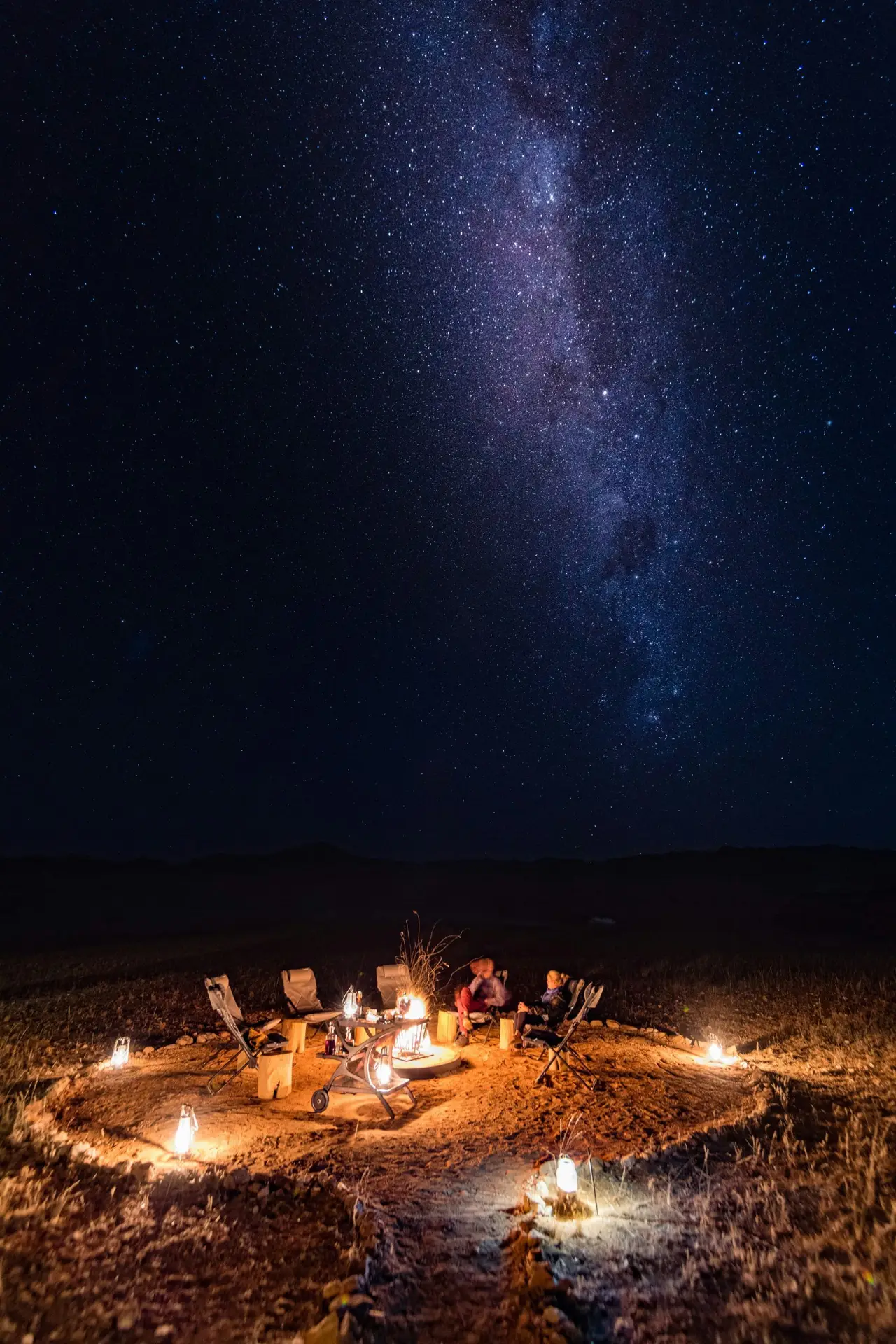
 Namibia is not a country you stumble into by accident. It’s a country you choose, and that choice says something about who you are as a traveller. Not because it’s hard to get there, but because nothing about it pushes itself on you. There are no beaches calling your name. No old town crammed with instagrammable cafés. No Eiffel Tower. Just a country the combined size of Texas and California, home to 2.5 million people, where quiet savannahs bleed into desert, desert bleeds into granite mountains, and those granite peaks stretch toward a sky holding twice as many stars as you’re used to seeing.
When I landed in Windhoek and sat in the car heading north toward Damaraland, twenty minutes passed without a single vehicle in the opposite lane. Not through a tunnel, not through forest. Just open road and a landscape that didn’t ask permission to take over your entire field of vision.
This is where people come to disappear. And Ultimate Safaris has built some of the world’s most carefully considered retreats right in the middle of all that nothingness.
Who is Ultimate Safaris, really?
Before I get into the retreats themselves, it’s worth understanding what this company actually is, because it’s fundamentally different from most safari operators. And to understand the company, you have to understand the family behind it.
Tristan Cowley’s parents, Clive and Doris Cowley, published Namibia’s first travel guidebook in the late 1980s. The Namibia Guidebook, now known as Clive Cowley’s Journey into Namibia, was the first work that gave visitors and would-be visitors a thorough introduction to the country. The Cowley family quite literally laid the groundwork for Namibian tourism.
Tristan, who trained as a natural resource manager and has published research in ornithology and small mammal ecology, was the first scientist to carry out a comprehensive study of Namibia’s only endemic predator, the black mongoose. He founded Tou Safaris in 2003. “Tou” means elephant in the Lozi language. That tells you where his priorities sit. In 2008, he merged with Martin Webb-Bowen’s SandyAcre Safaris, which had the BBC as a film support client and had been operating since 1994, and Ultimate Safaris became a reality.
Here’s what matters: this is a Namibian conservation organisation that happens to run tourism, not a tourism company pretending to care about conservation. That distinction sounds like marketing speak, but it’s actually a description of how the money moves.
Every animal you spot triggers a “wildlife sightings fee” paid directly to the conservancy. Every room pays an annual levy. In its first year of operation alone, Onduli Ridge contributed close to NAD 1.2 million to the conservancy, channelled over NAD 5 million into the Namibian supply chain, and invested USD 103,000 in two rhino relocations plus USD 162,000 toward human-wildlife conflict mitigation.
In 2023, they donated USD 450,000 (NAD 8.5 million) to conservation projects according to audited accounts. That included NAD 1.8 million for solar power in Tsiseb Communal Conservancy, NAD 1 million for predator-proof kraals, and over NAD 3.5 million to the Desert Lion Conservation Trust, AfriCat and Communal Conservancy Rhino Rangers. In 2024, they generated NAD 10.5 million in direct benefits for the conservancies they operate in. Altogether, they’ve invested over NAD 31 million in conservation and local development over the last five years.
When Covid shut down all tourism overnight, they produced “Covid Chronicles,” 66 episodes documenting life in the wilderness in real time. They kept their staff. They continued the Rhino Ranger work. That tells you something about what actually gets prioritised when nobody’s watching.
Ultimate Safaris Namibia: why this review matters right now
There’s an ongoing battle over the very land Ultimate Safaris operates on. An entity with mining interests in the Doro !Nawas Conservancy, where Onduli Ridge and Camp Doros are located, has attempted to nullify Ultimate Safaris’ tourism contracts through Namibia’s Competition Commission to clear the way for its operations. Cowley, a born Namibian, has gone on record about this publicly in The Namibian newspaper.
The case illustrates something concrete: conservation tourism of the kind Ultimate Safaris practises is currently the only thing keeping industrial mining out of this particular stretch of Namibia. NAD 10.5 million in direct conservancy benefits in 2024 gives local communities a real alternative to mining contracts. This isn’t abstract ideology. It’s economics.
When you choose to book here, you become part of that argument.
Choosing the right camp: the easiest decision you’ll make
Ultimate Safaris runs six permanent retreats, each with a different character, price point and focus. Here’s the breakdown:
| Camp | Focus | Price from (per person/night) | Best for |
|---|---|---|---|
| Onduli Ridge | Desert elephants, rhino (from night 3), architecture | ~$770 / NAD 14,071 | Couples, architecture lovers, photographers |
| Onduli Enclave | Private villa, same activities as Onduli Ridge | On request | Groups wanting the camp to themselves |
| Camp Sossus | Sossusvlei sand dunes, wildlife, design | ~$400 / NAD 7,385 | Families, those wanting the red dunes |
| Camp Doros | Black rhino from day 1, elephants from night 3 | ~$400 / NAD 7,385 | Rhino-focused travellers |
| Galton House | City hotel in Windhoek, breakfast included | ~$110 / NAD 1,979 | Start/end of a Namibia trip |
| Meru/Dome Camp | Mobile camp, maximum wilderness | On request | Those who want to go deepest in |
Onduli Ridge: the flagship
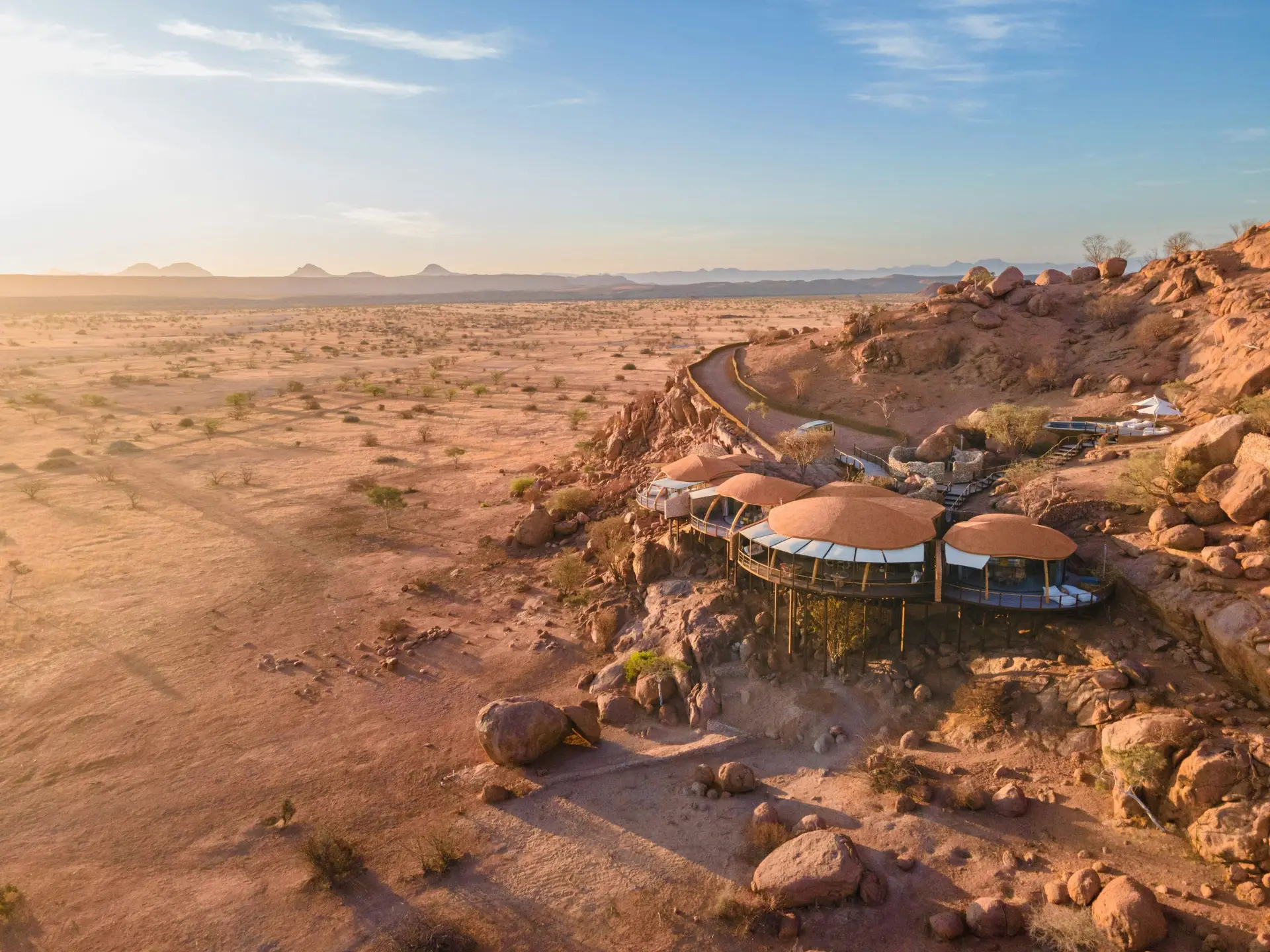
 Onduli Ridge is the camp most visitors choose, and it’s where the photos that stop you mid-scroll come from. Six suites built among granite boulders at the base of two south-facing granite formations connected by a ridge, named after a giraffe that has been living in the area since the camp opened. Each suite faces either Namibia’s tallest mountain, Brandberg, to the south, or the cathedral-like inselbergs to the north.
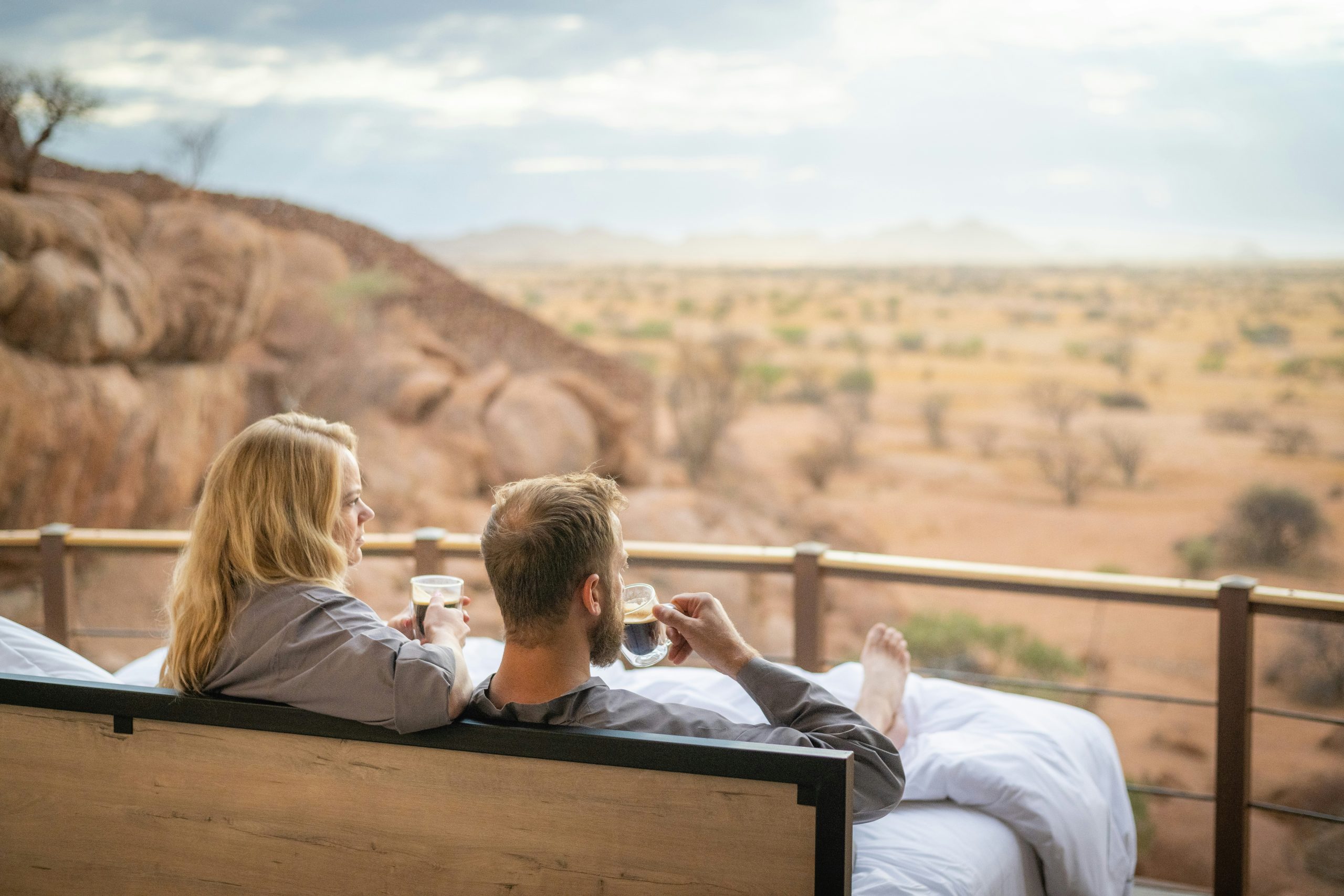
The architecture is designed around the view, not the other way around. You see the landscape from the bed, from the desk, from the shower. Louvred bi-fold doors open the entire wall to the outside, and that alone is enough to convince you someone thought hard about what a room is actually for.
The camp is 100% solar powered. All wastewater runs through a recycling system and gets pumped to wildlife waterholes. Solid waste goes to Windhoek for recycling. It all happens out of sight, as it should.
The room
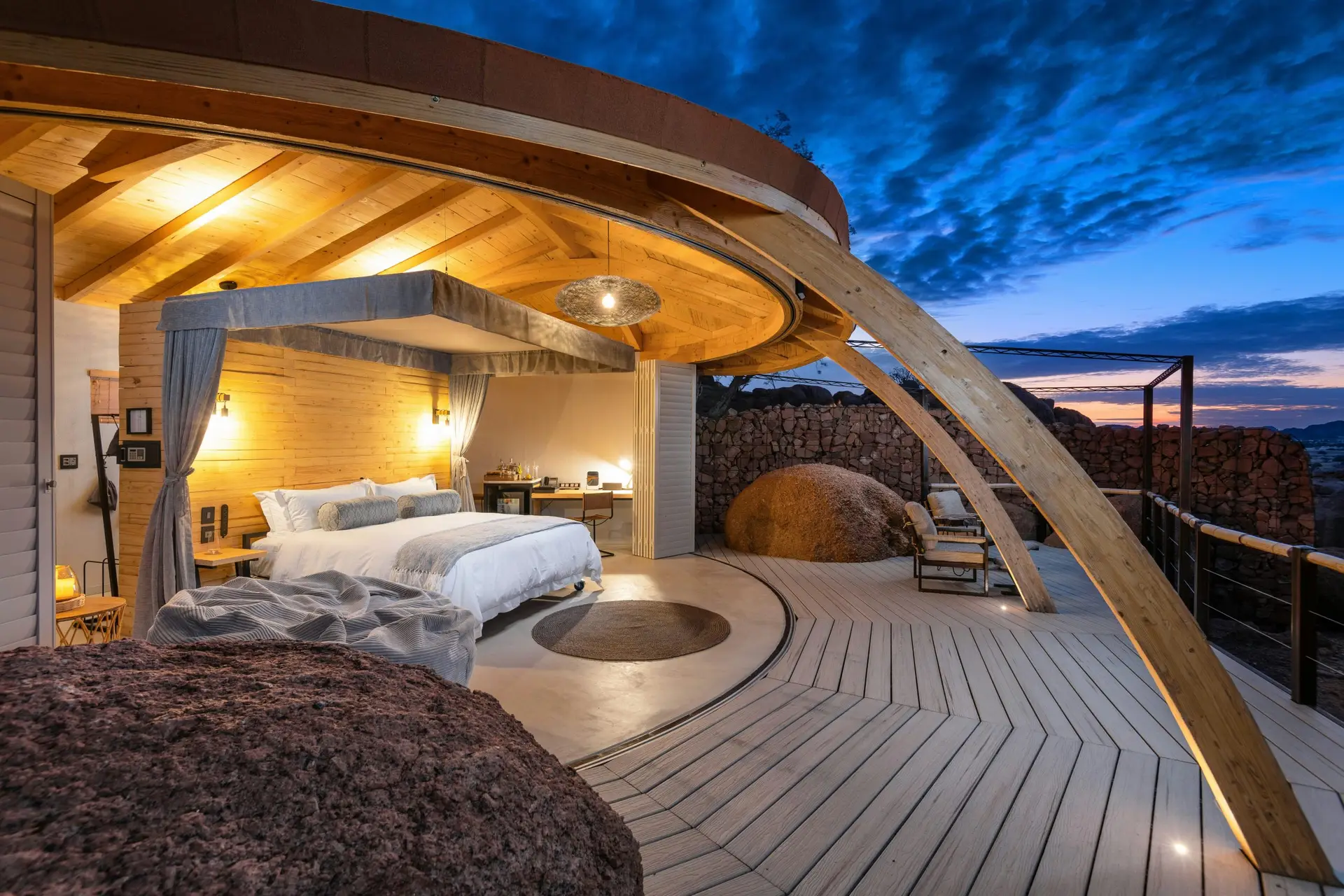 The bed is on wheels. That’s the most important sentence in this section. Staff roll it out onto the terrace in the evening and back inside in the morning. In between, you’re lying outside under a Namibian night sky, and it’s not an experience you can mentally prepare for.
Beyond that: the Evening Breeze system cools the bed silently through the night. Semi-open bathroom with a rain shower.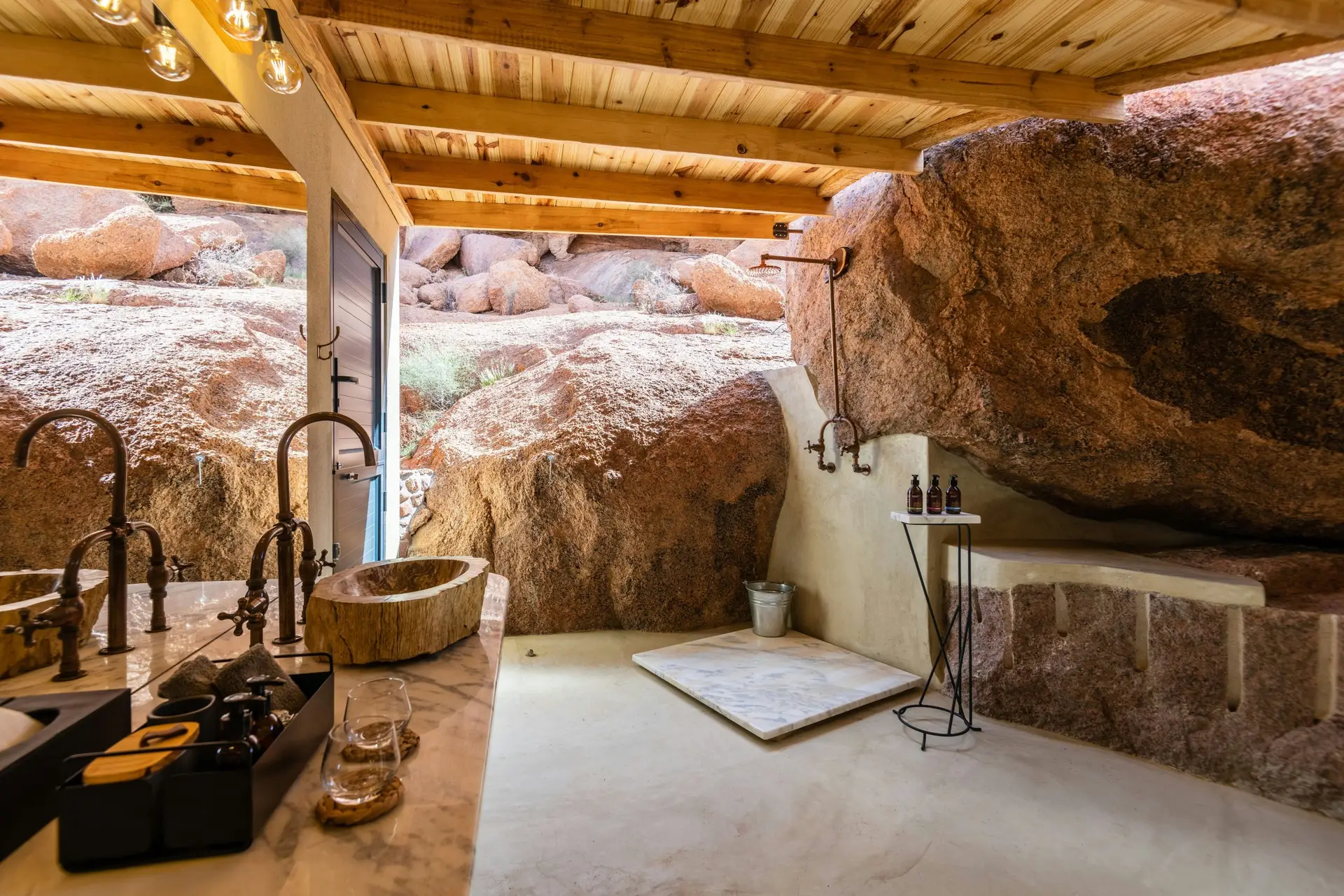 220V charging station. Mini fridge. Swarovski binoculars available. Wi-Fi in the room can be patchy, but there’s a separate Wi-Fi lounge in the common area.
The food and the evenings
 This is something no travel piece ever writes enough about: what actually happens between activities and sleep.
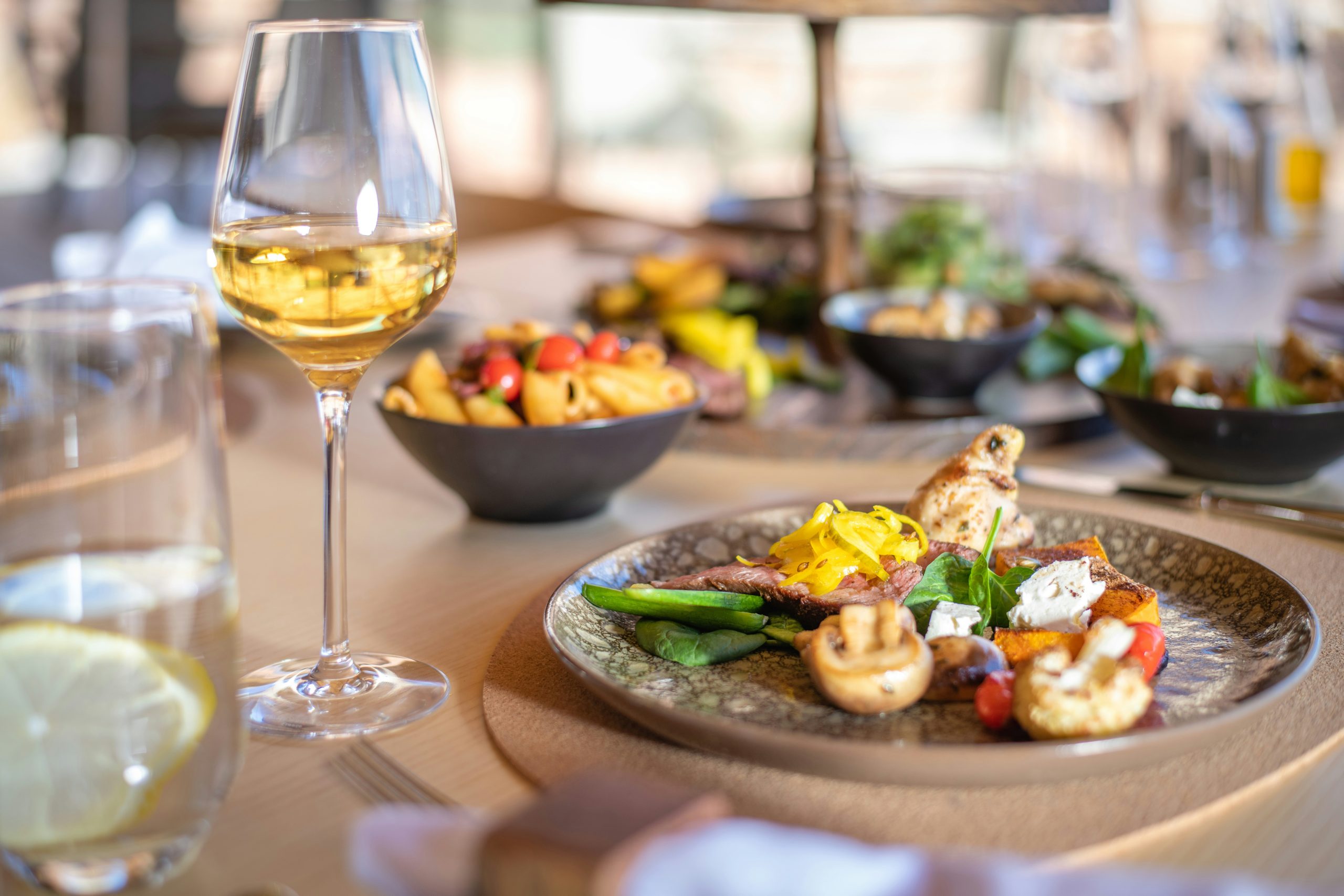
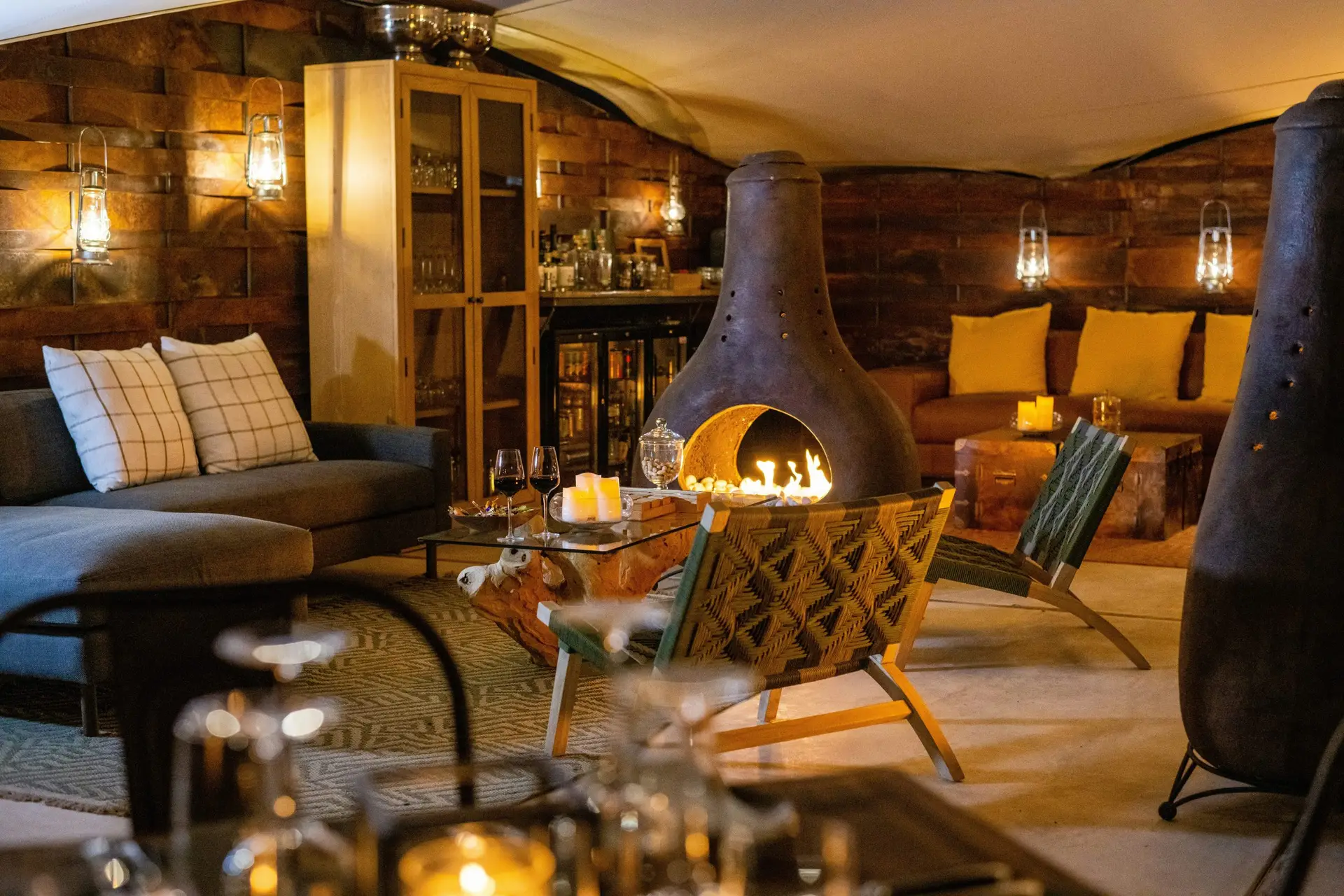
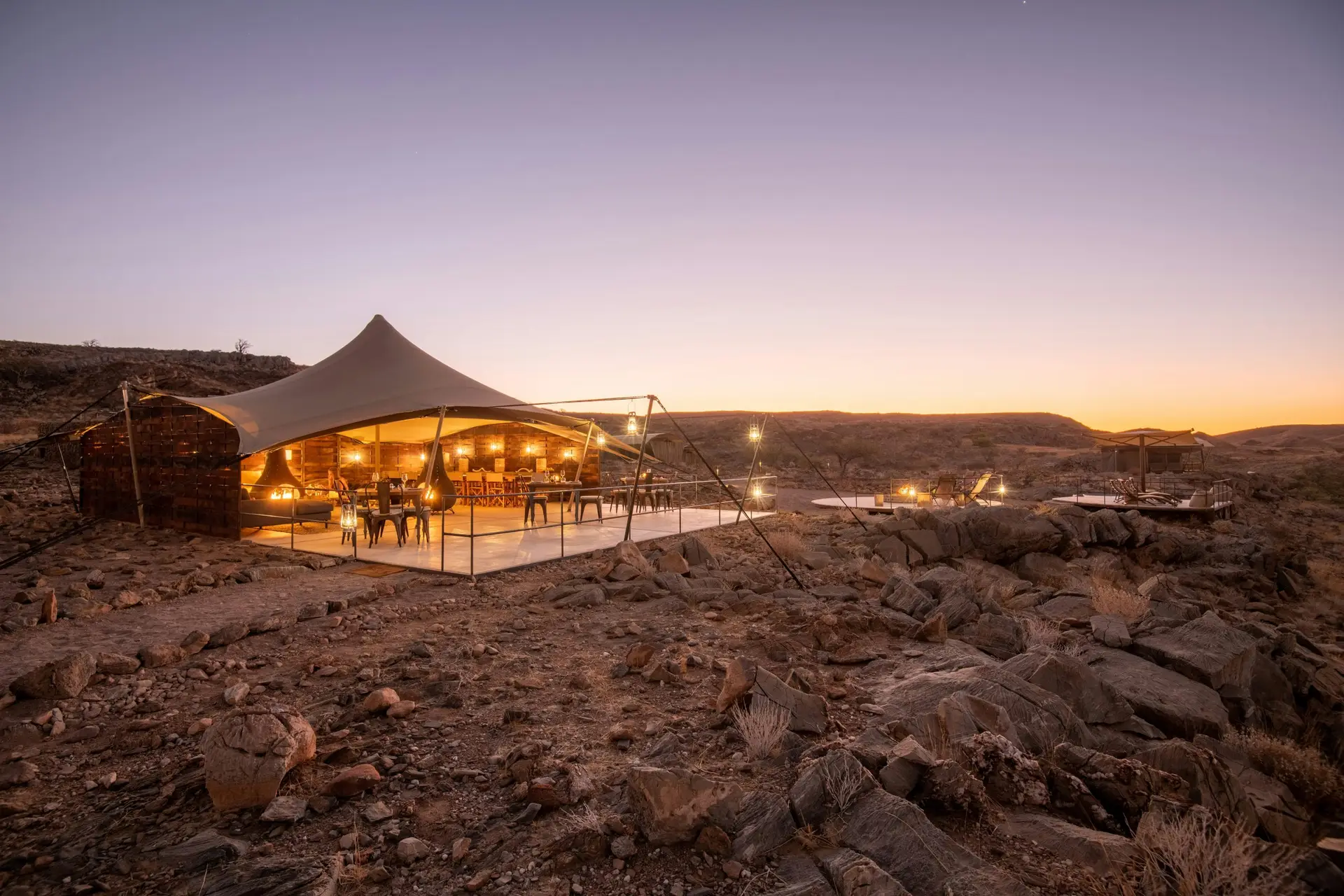
Dinner at Onduli Ridge is served in the open common area, where granite walls reflect firelight and candlelight. It’s a communal table. Six guests maximum means you know everyone by the first evening, and dinner either turns quiet and introspective or becomes one of those conversations you remember for years. Both happen, depending on who’s there.
Handmade pizza from a wood-fired oven is one of the evening traditions. Sounds trivial, but it’s one of those things guests write about on the way home. That pizza night in Damaraland.
After dinner: fire, stars, and the silence that is Onduli Ridge’s actual product. It’s not quiet in the sense that there’s an absence of sound. It’s quiet in the sense that you start hearing things you didn’t know were there: wind through granite, a night bird far away, your own breathing.
Activities at Onduli Ridge
Desert-adapted elephants (standard): Only two populations exist in the world. These can go four days without water and cover 70 kilometres a day searching for food. The guides actively track them using spoor and wind direction. There’s no guarantee. That’s the point.
Desert-adapted giraffes (standard): The endangered Angolan giraffe. The camp collaborates with the Giraffe Conservation Foundation to monitor and protect the local herd.
Black rhino with Save the Rhino Trust (requires 3+ nights): The world’s last free-roaming population of black rhino. Not in a fenced national park, but genuinely free. Two Rhino Ranger teams monitor every individual by name and family history. More on this further down.
Rock art at Twyfelfontein (standard): A UNESCO World Heritage Site, twenty minutes from camp, with over 2,500 San engravings dating back 6,000 years.
Geological attractions: Burnt Mountain, Organ Pipes, Doros Crater and the Petrified Forest, all within short driving distance.
Solar e-biking (standard): A 16 km scenic route. Quiet enough that you hear the desert landscape instead of an engine.
Spa (extra cost): Treatments available in the desert stillness.
 Onduli Ridge in numbers
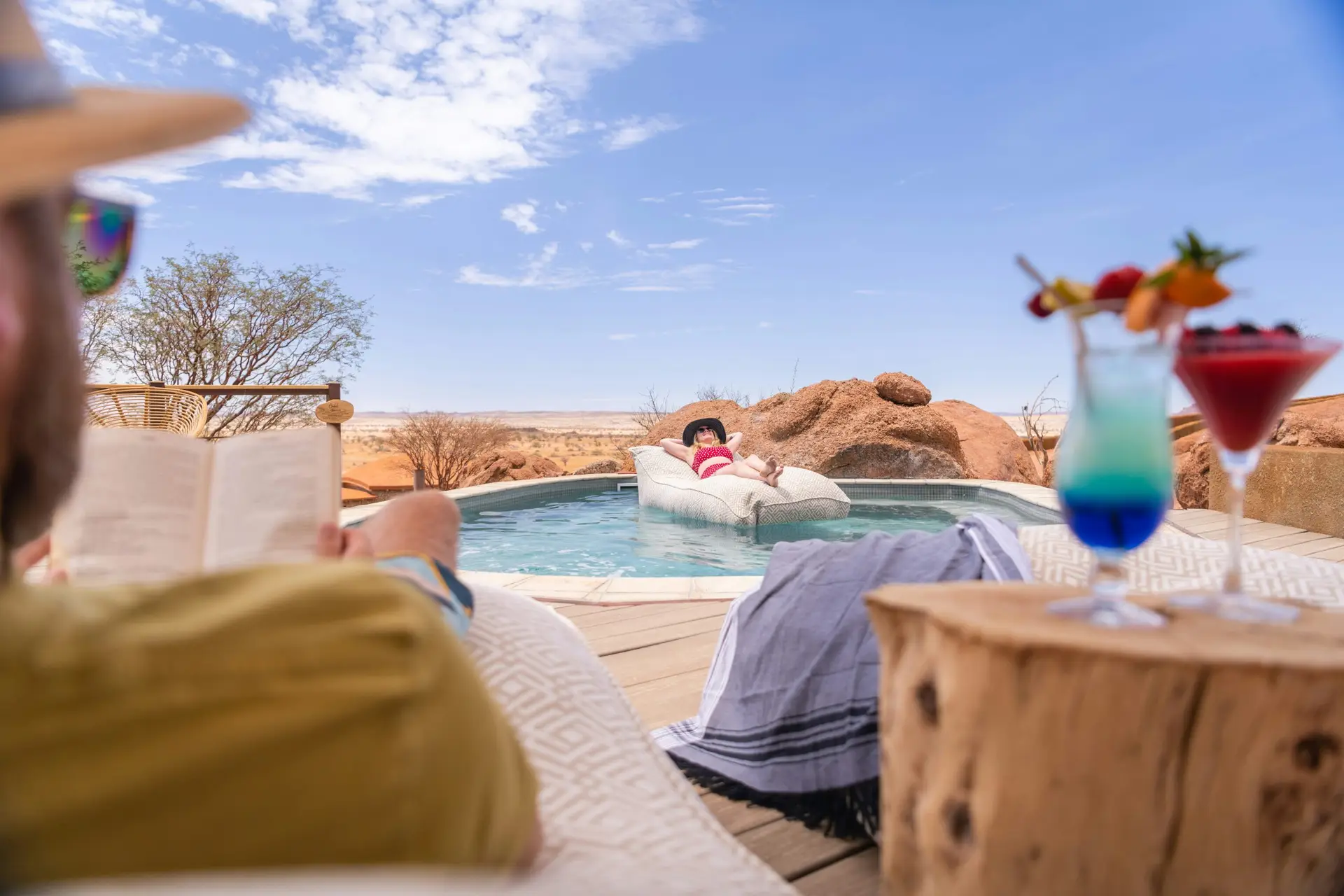
- 6 suites, maximum 12 guests
- Open year-round, minimum 2 nights (3 recommended)
- Shoulder season: from NAD 14,071 / ~$770 per person per night, fully inclusive
- High season: from NAD 18,334 / ~$1,000 per person per night
- Laundry service included, digital safe in-room, yoga equipment on the terrace
- Richard Bangs Best Hotels in the World Award 2024
- PURE Award for Creativity (innovative design, sustainability and conservation)
- Eco Awards Namibia 5 Flowers
- Featured in Condé Nast Traveller, The Times, National Geographic, Travel + Leisure
The guides: the thing nobody else writes about
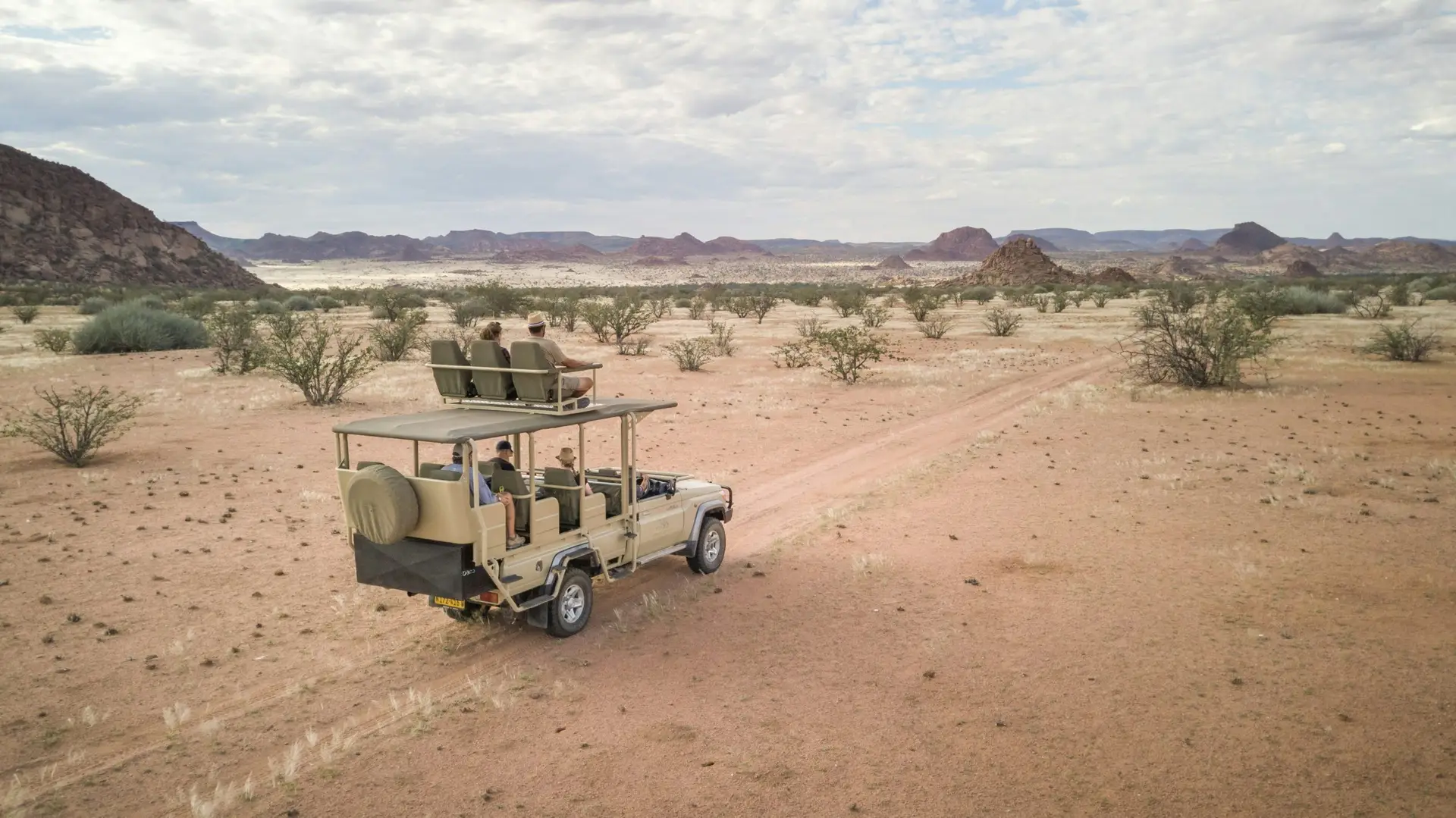 The guide is half the experience. Anyone who’s been on safari knows this. It’s just that most travel articles treat the guide as an amenity bullet point, like the swimming pool and included breakfast.
Franco Morao grew up at the SOS Children’s Village in Windhoek after being taken in as a two-year-old from a remote farm in eastern Namibia. As a teenager, the organisation “Children in the Wilderness” brought him on an excursion to Sossusvlei. He knew from the moment he arrived at the sand dunes what he’d do for the rest of his life. He started as a trainee guide in 2004, worked his way through wilderness safaris and private reserves, earned his national guide certification in 2012, and is now one of Ultimate Safaris’ resident naturalist guides with expertise spanning Sossusvlei, Damaraland, Etosha, Skeleton Coast and Kunene.
He’s one example. All Ultimate Safaris guides are Namibian, and all have backgrounds like this: shaped by the land they guide you through. They’re published writers, photographers, lecturers. Some know every individual rhino in their respective territories by name.
This isn’t a point for the brochure. It’s what determines whether a day out in the bush stays with you or doesn’t.
The rhino: the experience nobody else can give you
Let me put it plainly: seeing a black rhino in the wild, without fences, without motorways in the background, with a Rhino Ranger beside you who has followed this particular animal for ten years, is one of the most extraordinary experiences available to travellers on this planet today.
Namibia is home to the world’s last free-roaming population of black rhino. They are not in a reserve. They live genuinely free in Damaraland, and Save the Rhino Trust has been monitoring them continuously for decades. Without that work, they would not exist.
At Onduli Ridge, this requires 3+ nights and is conducted with the SRT team. At Camp Doros, it’s the standard activity from night one with two dedicated Rhino Ranger teams.
The camp directly finances: USD 103,000 toward two rhino relocations, ongoing ranger salaries, and monitoring equipment. Every “sightings fee” triggered by your spotting a rhino feeds into a conservation fund that ensures the next generation of travellers can have the same experience.
You can put a price on this experience in dollars and cents. You can’t put a price on the fact that it’s still possible.
Camp Sossus: the dunes and the impossible design
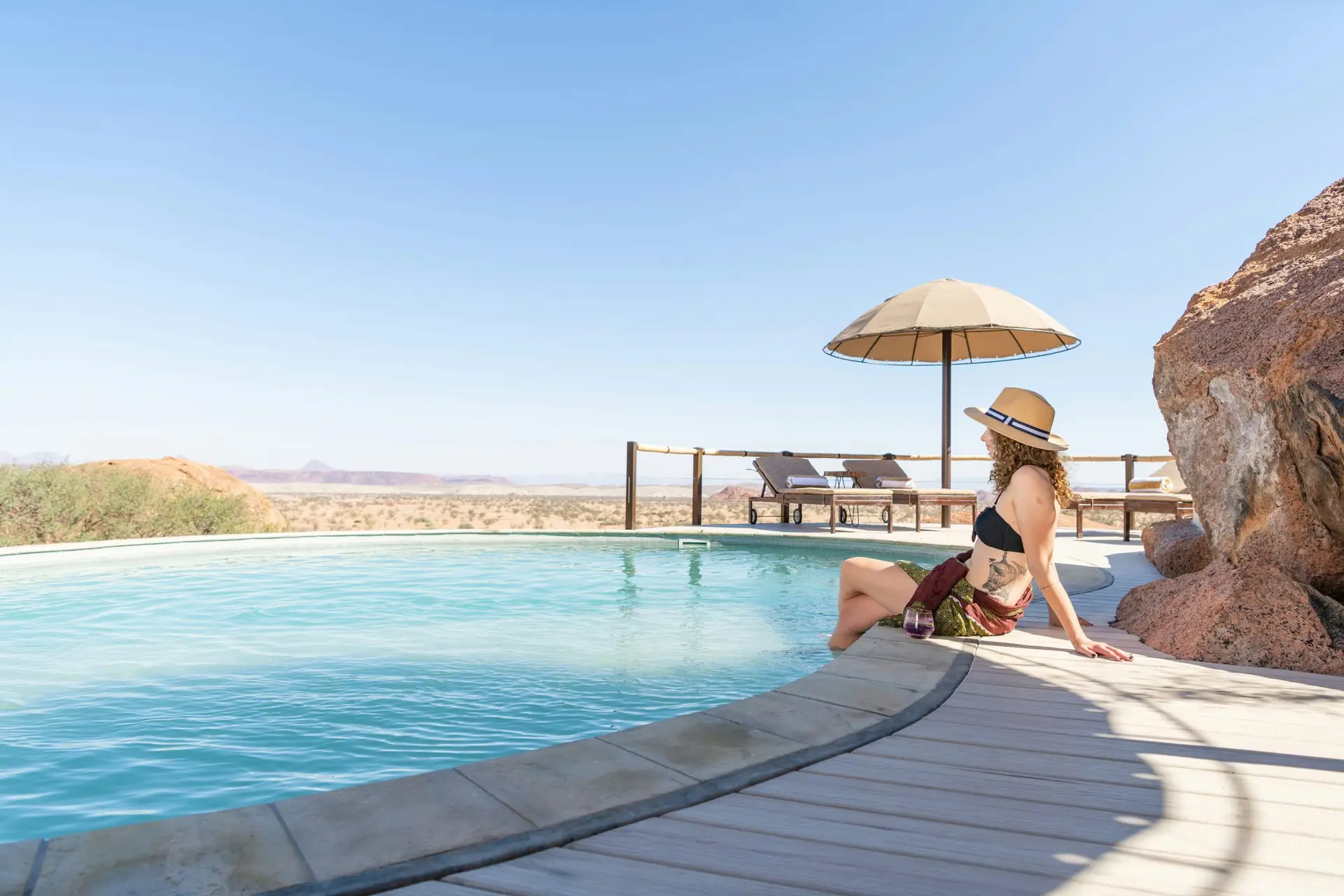 Camp Sossus is Namibia’s first camp built almost entirely from materials that would have otherwise ended up in a landfill. That’s not a PR talking point. It’s visible in the construction, and it earned a Design Africa nomination for it.
Located on the Namib Tsaris Conservancy, just 30 minutes from the Sesriem gate and the entrance to Sossusvlei. Six tent rooms with star beds positioned above the bathroom, a desert swimming pool, and a common area with just the right balance between openness and privacy. Naturally ventilated with large west-facing windows and south-facing doors that catch the prevailing afternoon breeze.
The conservancy was established in 2010 and has spent eight years reversing 60 years of misguided farming. Eighty-nine kilometres of internal fencing have been removed, waterholes installed, and wildlife is returning. It’s now home to oryx, springbok, Hartmann’s mountain zebra, kudu, giraffe, cheetah, leopard and spotted hyena.
Sossusvlei, which you visit from Camp Sossus, is one of the world’s most surreal natural spectacles. The red sand dunes reach 300 metres in height and are over five million years old. Deadvlei, the white salt pan dotted with blackened fossilised camel thorn trees, is one of the most photographed places on the planet. Being there between six and nine in the morning is the right call, before day-trip tourists arrive and the dunes shift colour from deep blue to orange in a matter of minutes.
Camp Sossus in numbers
- 6 tent rooms, open year-round, minimum 2 nights
- Shoulder season: from NAD 7,385 / ~$400 per person per night, fully inclusive
- High season: from NAD 8,754 / ~$475 per person per night
- Children from age 6, 50% discount for ages 6-12, no private vehicle required for families
- 5 rooms or more: exclusive use of the entire camp
- Eco Awards Namibia 5 Flowers, Design Africa nomination
Camp Doros: for those who are serious about rhino
Camp Doros is the camp for people who know exactly why they’re travelling to Namibia. No architectural showpiece, no iconic sand dunes, no e-bike routes. Just one of the last places on the planet where you can walk on foot through actual wilderness alongside a rhino that doesn’t know you’re there.
The camp sits on a high bank above a dry riverbed lined with mopane trees in the Doros Joint Management Area, a 19,000-hectare concession with natural springs providing water year-round. Six tent rooms on platforms, a campfire deck, and the lowest environmental footprint of any Ultimate Safaris camp.
Two separate Rhino Ranger teams from Save the Rhino Trust operate here continuously. They know every individual by name. They know which days a particular rhino uses a particular waterhole. They know which direction the wind needs to be blowing to approach without being detected.
An important logistical detail: Camp Doros is 75 minutes of nature driving from Onduli Airstrip, with pickup at 15:00. This is not an inconvenience. It’s an introduction to the territory you’re about to sleep in.
Activity hierarchy at Camp Doros (reversed from Onduli Ridge)
- Standard from day 1: Black rhino with Rhino Ranger teams, nature drives, guided bush walks
- Only with 3+ nights: Desert-adapted elephants, rock art visits
Camp Doros in numbers
- 6 tent rooms including one family tent, open year-round, minimum 2 nights
- From NAD 7,385 / ~$400 per person per night, fully inclusive
- Children from age 6, 50% discount for ages 6-12
- Private vehicle required for children under 12 (extra cost)
- Eco Awards Namibia 5 Flowers
Galton House: Windhoek done right
Most people treat Windhoek as a necessary transit point. Galton House turns it into something else.
Ten minutes from the centre, in a quiet villa suburb called Eros. Nine rooms lined with striking Namibian wildlife photography. Breakfast included. An interactive open kitchen where you can see what’s cooking. Early arrival and late departure day rooms with shower, toilet and repacking facilities, something you genuinely appreciate after a long flight.
Two activities here that nobody writes enough about: the Windhoek “Redefined” tour takes you through the city with local artists as guides, through neighbourhoods and murals and stories that aren’t in the tourist books. Mountain biking in the surrounding hills with a food stop along the way is the other one. Both give you a Windhoek you didn’t know existed.
TripAdvisor gave Galton House the Travelers’ Choice Best of Best in 2020, one of the rarer awards they hand out. It’s well earned.
Galton House in numbers
- 9 rooms: 5 double, 2 twin, 1 triple, 1 pool suite (converts to family room)
- Shoulder season: from NAD 1,979 / ~$110 per person per night with breakfast
- High season: from NAD 2,258 / ~$125 per person per night
- Pool suite from NAD 2,693 shoulder / NAD 3,052 high season
- No minimum nights, open year-round, Wi-Fi, 100% solar powered
- TripAdvisor Best of Best 2020, Certificate of Excellence 2014-2018
Is it worth the money? The maths nobody does
$770 per person per night sounds expensive. Let me put it in context.
A week at Onduli Ridge for two people runs roughly $10,800 fully inclusive: all meals, all activities, all transfers from Windhoek. Compare that to a week of all-inclusive on the Maldives for two, which easily hits $12,000 and up once you add flights. Suddenly Onduli Ridge is actually competitive, and you’re trading a sun-lounger experience for one of the most extraordinary encounters with nature on the planet.
Camp Sossus and Camp Doros at around $400 per person per night are honestly good value for what they deliver. A comparable camp standard with &Beyond or Singita in Botswana costs two to three times more.
Head-to-head with the competition:
- &Beyond Sossusvlei Desert Lodge: Spectacular, internationally renowned, but starting around USD 1,800 per person per night and not as deeply integrated into local conservation work.
- Singita in South Africa/Tanzania: The pinnacle of African safari luxury, but from USD 2,000+ per night and a completely different price bracket.
- Wolwedans Dune Lodge: Strong Namibian competitor with solid conservation credentials, more landscape-focused than wildlife-driven. From roughly USD 800 per person per night.
- Hoanib Skeleton Coast Camp: For those wanting to push further toward the Skeleton Coast, more stripped-back, from around USD 1,500 per night.
Ultimate Safaris is priced smartly: Onduli Ridge competes on quality with the very best, but at half the price. Camp Doros and Camp Sossus give you rhino and sand dunes at rates where there’s barely any competition.
Namibia month by month
 January to April (rainy season): Namibia changes character entirely. It greens up in a way that surprises everyone. Birdlife is at its richest, a paradise for photographers who want something different from the classic red dune shots. Prices are lower, fewer guests. The elephants spread out and are harder to find, but lions and leopards are easier to spot in the lower vegetation. Underrated season.
May to June (transition): 15-25°C, soft light, vegetation dries out and makes animal tracking easier. One of Namibia’s best-kept secrets: this is a fantastic time to visit, without peak-season prices or booking pressure.
July to August (high season): The recommended window for most visitors. Down to 5°C at night, bring a wool jumper. Wildlife gathers around waterholes. Rhino tracking is easiest now because vegetation is drier and sightlines are longer. Book 6 months ahead, 12 months for Christmas and New Year.
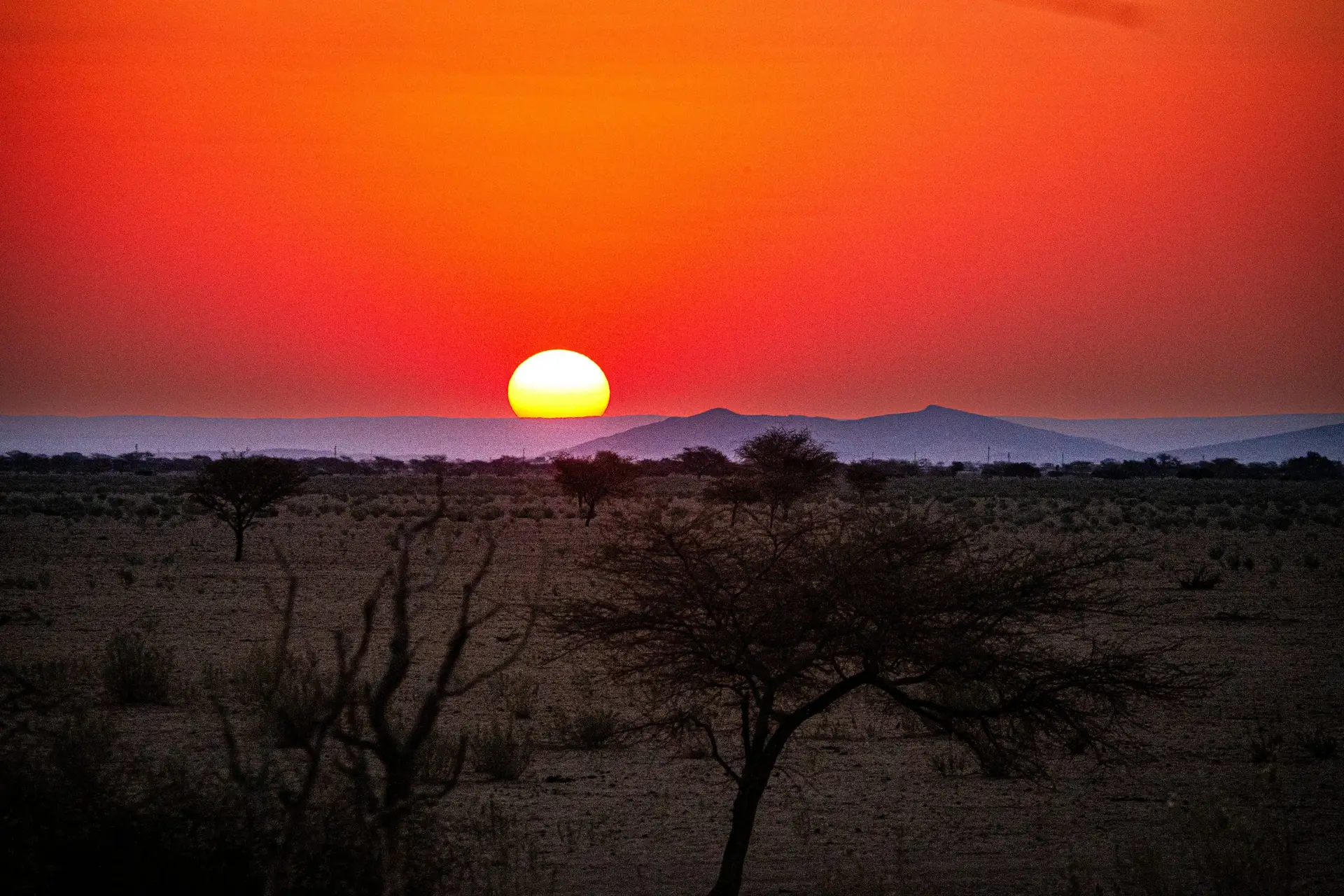
September to October: Up to 35°C during the day, but wildlife is at peak concentration around water. Dramatic golden light in the hours around sunset that Namibian photographers can’t get enough of.
November to December: The first rains start. Elephants are actively moving again. For the Christmas holidays: book a year in advance.
Stargazing: Best May to October on moonless nights. The camp sits at 1,500 metres elevation and there’s barely any light pollution for hundreds of kilometres. Namibia is one of the few countries with officially certified Dark Sky zones. The Milky Way isn’t a band. It’s a wall of light.
What actually happens in the evening?
It’s a question no travel guides ask, but it determines whether you’re happy or not.
Onduli Ridge and Camp Doros have communal dinner tables. With six guests maximum, that means you sit with the same people every evening, and it’s either stimulating or draining depending on who’s there. Most guests find it stimulating, because the kind of people who choose to travel here tend to have something to say. But it’s worth knowing in advance if you’re the type who prefers to eat alone.
After dinner it’s fire, starlight and optional silence. There’s no all-inclusive bar, not because of any health agenda, but because the camp is selling something other than a buzz. Drinks are available for purchase, but the prevailing evening mood is calm, sensory, a little meditative.
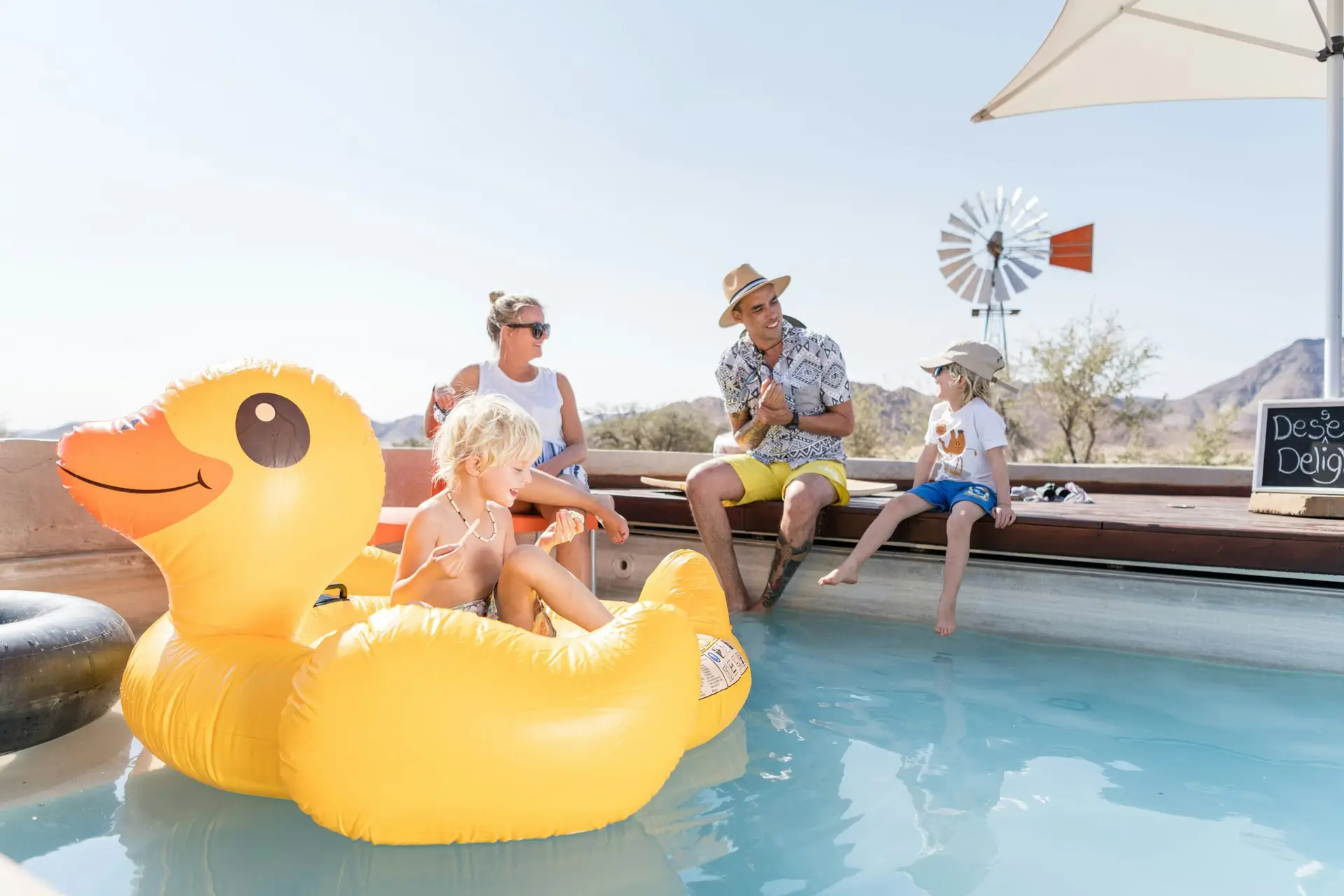
Camp Sossus is a bit different. With the option for exclusive use and families with children, the atmosphere is more active and social. The pizza nights are an institution. Kids helping out in the kitchen is not uncommon.
 Families: the most honest guide you’ll find
Ultimate Safaris is family-friendly, but there are important differences between camps that no other travel article spells out clearly.
Camp Sossus is the obvious family pick. No private vehicle requirement, children 6-12 pay 50% of the adult rate, kids’ menu and family-friendly activities are standard. Book 5 rooms or more and you get exclusive use of the entire camp. Two-way radios available for families staying in multiple tents.
Onduli Ridge and Camp Doros require a private vehicle for children under 12, which costs extra and is not included in the standard rate. The pool at Onduli Ridge has no fencing, and there are plenty of natural drop-offs in the surrounding terrain. Children must always be supervised. The rhino tracking at Camp Doros is on foot over rough ground for several hours, which requires kids who can actually handle it.
Galton House in Windhoek has a pool suite that converts to a family room, no activity restrictions, and satellite TV in the room.
 For couples and honeymooners
Onduli Ridge is consistently named among the best honeymoon destinations in Africa by travel experts. Not by accident. Six guests maximum, shared night sky, no children running about, and rooms designed to open completely onto a landscape that makes everything else feel small. That combination is hard to replicate elsewhere.
Practical details for couples: yoga equipment is available on the terrace. Laundry service is included in the room rate. Digital safe in-room. The bed can be rolled out for a private stargazing experience on your own terrace without the neighbouring suite seeing you.
Special occasions like wedding anniversaries or birthdays can be flagged at booking, and the camp team typically tailors the experience accordingly. It’s communicated discreetly and without promises of spectacle, which is exactly right for a place like this.
For those wanting to combine Onduli Ridge with a classic romantic Namibia circuit: add Wolwedans Dune Lodge in NamibRand after Sossusvlei, and finish with Victoria Falls in Zimbabwe for a ten-day honeymoon covering desert, wildlife, sand dunes and the world’s largest waterfall.
 Safety and medical preparedness
This is something any article should state clearly: Onduli Ridge and Camp Doros are extremely remote. The nearest hospital with acceptable standards is in Outjo, roughly 2.5 hours’ drive from Onduli Ridge. In emergencies, guests can be flown to Windhoek. Management and guides are present at camp around the clock, and fire extinguishers are in the suites and common area.
Practical preparations:
- Travel insurance with evacuation cover is mandatory, not optional. Medical evacuation from Damaraland is expensive without insurance.
- Bring personal medication for the entire trip. The nearest pharmacy is in Outjo or Swakopmund.
- Inform the camp team about allergies and medical conditions at check-in. They handle it professionally and discreetly.
- Existing spinal or knee issues should be discussed with Ultimate Safaris beforehand. The safari vehicle has a high step-in and the boots are solid, but the ride on gravel roads is bumpy.
Suggested itineraries
Classic Namibia circuit (12-14 days): Windhoek via Galton House (1 night) then fly to Onduli Ridge (3-4 nights, include rhino) then fly to Camp Sossus (2-3 nights, Sossusvlei) then the Etosha area for classic savannah safari (2-3 nights). Covers all the major Namibia experiences.
Rhino intensive (6-8 days): Onduli Ridge (3 nights, rhino on day 3) then Camp Doros (3 nights, rhino from day 1). Same airstrip, easy to combine. You end up with six days in rhino territory with two different teams and two different landscapes.
Desert and dunes (7-8 days): Galton House (1 night) then Camp Sossus (3 nights, Sossusvlei) then Onduli Ridge (3 nights, elephants and rock art). From the sand dunes in the south to granite inselbergs in the north.
Budget-smart: Camp Doros (2 nights, rhino from day 1) plus Camp Sossus (2 nights, Sossusvlei). Roughly $1,600 per person total for four nights covering Namibia’s two most important experiences. Add 2 nights at Onduli Ridge for architecture and star beds, and unlock a 15% discount on the entire trip.
6-night discount: 6+ nights total across Ultimate Safaris camps gives you 15% off. Mention it explicitly when booking.
The downsides: read this before you book
Extremely remote. No restaurants, no shopping, no town nearby. Galton House in Windhoek is the exception. If you need urban stimulation, you’ll get restless.
Nothing is guaranteed. You might not find rhino. The guides are experts, but nature decides. That’s the whole point, but be mentally ready for it.
Wi-Fi is unreliable in the rooms. Every camp has a separate Wi-Fi lounge in the common area that works better. Don’t plan on working from here.
The climate is extreme. 35-40°C on summer days, down to 5°C on winter nights. Pack for both regardless of season.
Camp Doros: 75 minutes from the airstrip. Not a downside if you know about it, because then it’s an experience. If you don’t know about it, it’s a surprise.
Rhino tracking requires physical fitness. You walk over uneven terrain for several hours. Talk to Ultimate Safaris beforehand if you have mobility issues.
Dinner is communal. Six guests, shared table. Not for everyone. If you know in advance, you can plan accordingly.
Insider tips
Choose Camp Doros if rhino is your number one priority. Same price as Camp Sossus, rhino from day one without the three-night minimum. Most people don’t know this.
Twyfelfontein early in the morning. Day buses arrive between 9 and 11. The guides from Onduli Ridge know this and time your visit so you’re there in peace and quiet.
Fly one way, drive the other. Namibia’s landscape from the air is a separate experience entirely. And the roads from Windhoek through Damaraland are among the most beautiful drives in the world.
Star beds: pack extra warm. The temperature drops sharply at night regardless of season. Ask for extra blankets at check-in.
Rainy season is underrated. January to April brings greener landscapes, half the usual guests and lower prices. The birdlife is exceptional.
Pack for Conservation. You can donate directly to the Rhino Ranger programme at checkout. It’s concrete, verifiable, and makes a noticeable difference.
Book the rhino tracking at Onduli Ridge when you make your reservation, not on arrival. It’s coordinated with Save the Rhino Trust and requires planning.
For photographers: what actually works here
Since the images from Ultimate Safaris are the reason many of you found this article, the photography deserves its own section. Damaraland is not like other photography destinations. The light is extreme, the dust is everywhere, and the animals are moving far away. Here’s what actually helps.
Lenses
Bring two. A telephoto zoom in the 100-500mm or 200-600mm range is your primary wildlife lens: elephants often keep 100-200 metres of distance, and you’ll want the rhino filling the frame, not sitting as a grey speck in the distance. A wide-angle zoom at 16-35mm is essential for the Sossusvlei dunes, for the night sky, and for telling the story of the landscape’s scale. Never change lenses out in the field. Damaraland dust settles on the sensor immediately.
The light
The first and last two hours of the day are the only ones that truly matter for landscapes here. The midday light in Damaraland is brutal, flat and merciless. The white limestone cliffs and red granite during golden hour are a different universe from what you see at noon. Set the alarm.
For Sossusvlei: be at the dunes at sunrise, not at eight o’clock. The first twenty minutes after the sun clears the horizon are the only ones where the full colour range from deep russet to pale gold exists. After that, it’s just orange.
Stargazing and astrophotography
Namibia is one of the darkest countries on the planet. For the Milky Way you need a fast wide-angle prime, f/1.4 or f/1.8 at 14-24mm, high ISO (3200-6400), and a tripod. Best nights are around the new moon from May through October. The camps have no outdoor lighting to interfere, and the guides can tell you exactly which direction to point at which hour of the night.
Practical advice
- Dust cover is not optional. Damaraland is dry and windy. Clean the sensor and lenses every evening. Bring a rocket blower and microfibre cloth.
- Extra batteries. Charging is available but limited at the camps. Two spare batteries minimum per camera body.
- Plenty of memory cards. A good day with elephants and evening light can chew through 500-800 RAW files.
- Beanbag on the car windowsill. Ultimate Safaris’ safari vehicles come equipped with these. Use them. A tripod is unnecessary for wildlife but essential for night sky.
- Polarising filter for the dunes. Cuts through the harsh sky and deepens the red sand colours dramatically. Makes a big difference at Sossusvlei.
- No flash. It’s prohibited and disturbs the animals. Push the ISO instead.
What to pack
Namibia isn’t hard to pack for if you know what you’re walking into. Here’s what you actually need, not the list travel agencies put together to look thorough.
Clothing
- Layers are the key principle. Mornings and evenings can be 5°C even when daytime temperatures hit 30°C. A thin down jacket or fleece that fits in a daypack is essential.
- Neutral colours. Tan, olive, khaki. Avoid white and bright colours on safari. It’s not aesthetics, it’s etiquette.
- Long sleeves and trousers in the evening. Not for mosquitoes, which are minimal in Damaraland. For the evening chill and sandstorms.
- Sun hat with a brim. Wide brim, not a baseball cap. Namibian sun is unforgiving.
- Solid walking shoes or boots. Rhino tracking is over rock and gravel. Sandals won’t cut it.
Health and safety
- Sunscreen SPF 50+. Bring more than you think you need.
- Lip balm with sun protection. Namibian dry air cracks your lips within two days.
- Rehydration salts. The heat and activity mean you lose salt faster than you’d expect.
- Travel medical clearance and insurance. The nearest hospital of any standard is in Swakopmund or Windhoek. Have evacuation insurance.
- Malaria is not prevalent in Damaraland, but always check current advice from your national health authority.
Technical
- Universal travel adapter. Namibia uses Type D and M outlets (15-amp round pins). Standard European adapters don’t always fit.
- Power bank. Charging is available but limited at the wilderness camps.
- Offline maps. Download Maps.me or Google Maps offline for the Damaraland region. Mobile coverage outside Windhoek is unreliable.
What you don’t need
- Formal clothes. Nobody wears them.
- An umbrella. The camps have roofing where it’s needed, and rain is scarce.
- Lots of makeup. Dry air and sun render it pointless.
- More than one bag. Fly-in safaris have baggage limits, usually 15-20 kg in soft bags, no hard shells.
Questions and answers
Is there a luggage limit on fly-in flights? Yes. Charter flights to the wilderness camps typically have a 15-20 kg limit in soft bags (no hardshell suitcases). Confirm with Ultimate Safaris when booking. It’s strict.
Can I use the photos from their Unsplash account? Yes. The images at @ultimate_safaris_namibia on Unsplash are licensed under the Unsplash licence and can be used freely, including commercially, with credit.
Is Ultimate Safaris the best safari company in Namibia? They are consistently ranked among the country’s absolute best, with Tour Operator of the Year 2025 and a string of international awards. For conservation-based safaris focused on rhino and desert elephants, they’re unmatched. For those prioritising Etosha and classic savannah safari, there are other solid options.
What does it cost? Onduli Ridge from roughly $770 per person per night fully inclusive (shoulder), around $1,000 (high season). Camp Doros and Camp Sossus from approximately $400. Galton House from about $110 with breakfast.
What’s included? All meals, all standard activities, beverages except alcohol. Rhino tracking at Onduli Ridge (3+ nights), spa, alcohol and private vehicle for families are extras.
Which camp is best for rhino? Camp Doros: standard from day 1, two Rhino Ranger teams. Onduli Ridge: available from night 3. Same animals, two different setups.
Which camp is best for families? Camp Sossus: no private vehicle requirement, 50% discount for children 6-12. Camp Doros and Onduli Ridge: private vehicle required for under-12s.
Can I combine camps? Yes, and you should. 6+ nights gets you 15% off.
Can I fly in? Yes, all wilderness camps have their own airstrips or pickup points. Ultimate Safaris coordinates charters from Windhoek.
Do I need a visa? Most nationalities get visa-free entry for up to 90 days. Check your country’s requirements.
Is there a malaria risk? Not prevalent in Damaraland. Always check current travel health advice from your national authority.
Practical information
Address: 5 and 7 Brandberg Street, Eros Park, Windhoek, Namibia Phone: +264 61 248 137 Email:info@ultimatesafaris.na Emergency phone outside office hours: +264 81 141 2275 Website: ultimatesafaris.naBooking: Direct through the website, or via an Africa specialist who has visited Namibia in person. Ultimate Safaris recommends this themselves, which is unusually honest. Currency: Namibian dollar (NAD). 1 USD equals roughly 18-19 NAD (April 2026). Getting there: Windhoek Hosea Kutako International Airport. Direct flights from Frankfurt (Condor, Lufthansa) and London Heathrow (British Airways). From most other cities via Frankfurt or Johannesburg.
What you take home
I thought about Franco for a long time after getting back. Not about the elephants we found, not about the hotel, not about the food. About the way he knelt in the sand and held his hand over those tracks without saying a word for eighteen seconds.
There’s something in that gesture about respect for something you don’t own. Namibia doesn’t belong to tourists, and it barely belongs to Namibians. It belongs to the animals that have been there for millions of years, and to the people who spend their lives making sure those animals are still there the next time someone arrives on a small plane with binoculars and the hope of seeing something real.
Ultimate Safaris doesn’t sell you a package. They sell you access to something that exists independently of them, and that will keep existing because they and the people they work with look after it. The rhino you see today is there because someone paid to protect it for decades. The elephant that doesn’t notice you because you’re downwind is there because a guide spent twenty years learning to read wind and sand and tracks.
Next time someone sees them, it’s partly because you were there.
That’s a rare thing to be able to say about a holiday.
 Ultimate Safaris. 5 and 7 Brandberg Street, Eros Park, Windhoek, Namibia. ultimatesafaris.na. Onduli Ridge from approximately $770 per person per night fully inclusive. Camp Sossus and Camp Doros from roughly $400 per person per night fully inclusive. Galton House from around $110 per person per night with breakfast. Contact: info@ultimatesafaris.na